


Essay by Eric Worrall
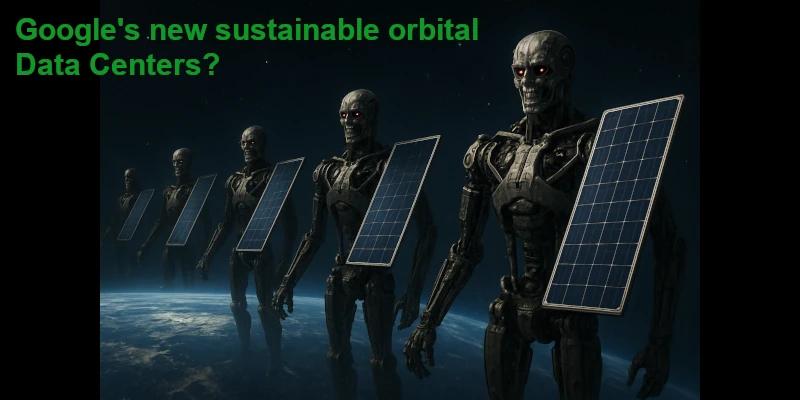
Sadly they decided to call the project “Suncatcher” rather than “Skynet”.
Sundar Pichai says Google will start building data centers in space, powered by the sun, in 2027
- Google unveiled Project Suncatcher earlier this month.
- It aims to reduce AI’s environmental impact by relocating data centers in space, powered by the sun.
- Google CEO Sundar Pichai said the company plans to begin sending ‘machines’ to space next year.
The great AI space race has begun.
Google has been quietly working on a long-term research initiative, internally known as Project Suncatcher, to “one day scale machine learning in space.”
Google CEO Sundar Pichai told Shannon Bream on Fox News Sunday thatGoogle’s goal is to start putting data centers in space, powered by the sun, as soon as 2027.
“We are taking our first step in ’27,” he said. “We’ll send tiny, tiny racks of machines, and have them in satellites, test them out, and then start scaling from there.”
In a decade, Pichai said that it’ll be normal to build extraterrestrial data centers.
…
Google’s cosmic pivot comes amid growing global scrutiny over the power demands of data centers.
…
There might be a few issues with this plan.
Obviously there is the launch cost. Even with the insane cost of data center components, the cost of launching the whole assembly into space adds significantly to the overall cost, along with the cost of sending technicians into orbit to service the equipment.
But the biggest issue with orbital data centers might be heat dissipation. Data centers which consume hundreds of megawatts have to dissipate all of that energy as heat.
Most people think of space as cold, but for heat emitting systems like machines or humans in spacesuits, space functions more like a giant vacuum flask. The kind of vacuum which keeps your Thermos of soup hot all day on Earth completely surrounds anything you put into orbit.
On Earth, data center heat dissipation is a barely manageable problem. Data centers on Earth pump out so much heat, a sizeable portion of the cost of a constructing a data center is building the cooling system.
In space the heat dissipation problem will be far worse – you can’t just dump all the heat into a convenient large body of water located next to your data center, all the heat has to be radiated into the vacuum of space without any help from air convection.
I read the Google press release on their new orbital data center idea, and not once did they mention heat dissipation or cooling.
Why is Google advocating such unlikely sustainability ideas? First claiming data centers will be powered by nuclear fusion in the next decade, now claiming they’ll put all the data centers in space and power them with solar energy?
These grandiose plans might just be a manifestation of late stage investment bubble fever. But I wonder how bad Google’s internal divisions are, whether Google management is catching a lot of internal heat over their skyrocketing data center CO2 footprint? Perhaps these wild sustainability plans are a desperate attempt to pacify Google’s in-house climate worriers – at least until skynet suncatcher is ready to take over all the programming jobs. But that’s just my own wild theory.
Discover more from Watts Up With That?
Subscribe to get the latest posts sent to your email.