


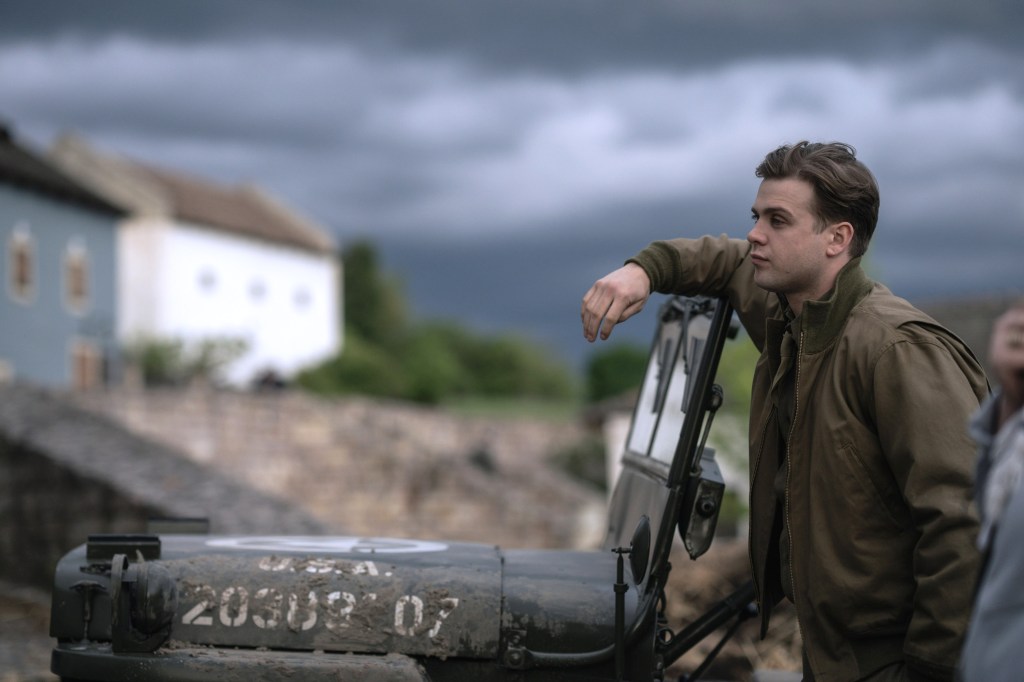
British actor Leo Woodall, aged 29, has smashed it playing Renee Zellweger’s hunk du jour in Bridget Jones: Mad About the Boy, a heartthrob in Netflix weepie One Day and by playing leads in television dramas. Now, he excels in portraying Sergeant Howie Triest, a young U.S. interpreter tasked with translating the words uttered by Nazi war criminals in director James Vanderbilt’s Nuremberg, which sees him step up against Academy award-winning stars Russell Crowe as Luftwaffe supreme commander Hermann Göring and Rami Malek as American psychiatrist Douglas Kelley. Next year, Woodall will be seen in Daniel Roher’s Tuner opposite two-time Oscar winner Dustin Hoffman.
DEADLINE: Howie can’t let those Nuremberg Nazis know his real background — that he’s Jewish — he has to keep it from them and that underpins your performance.
LEO WOODALL: I loved playing Howie, not just because he was such an extraordinary man. It’s funny because Howie, he was there in the room, and I felt like I was there in the room for Rami and Russell’s dynamic, and it was fascinating for me to get to experience that. There were so many fascinating conversations between those two, between Rami and [Rudolf] Hess and Rami and [Julius] Streicher that Howie was in the room for that no one else really necessarily got to experience firsthand. So, it was really wonderful for me to get to be there for that, but also to have this whole other thing happening that the Nazis don’t know about.

Woodall and director James Vanderbilt on set for ‘Nuremberg.’
DEADLINE: How did you ensure that your German was fluent? It’s been said that you couldn’t speak a word of the language before you heard about the movie.
WOODALL: I can’t fully remember how much I was given for the first round of auditioning which was just a self-tape. There was lots of German and I learnt as much as I could. But there was so much of it that I remember thinking, OK, I’m going to flunk this whole tape if I try and get every single sentence in. So, I’m actually just going to do that portion and let it breathe a little bit. But then I met with Jamie [Vanderbilt] and he gave me more and more information to work with. But then it was a while before I eventually got the role and I’d kind of given up hope at that point. I’d thought about it a lot. I had tried to manifest it and it was at a point where I was like, “It’s done. It’s not going to happen.”
There was a particular day where my whole team were like, “Are you free today for a call?” And whenever your whole team wants you to jump on a call, you think, “There could be some news here.” I thought, I wonder if it’s Nuremberg. I really f*cking hope it is. It was a really joyful moment.
DEADLINE: How did you tackle the actual studying of German?
WOODALL: I had a German coach. Her name is Lena Lessing. She was wonderful and she was very patient with me; very encouraging. We worked once or twice a week on Zoom.
We didn’t meet in person until we were on set together. And I am going to give a little bit of luck to it that I just could make some of the sounds. But it was hard work. It was one of the hardest things that I’ve had to learn to do for a role. And there were points where, because my first day was with Rami and Russell translating the first time their characters meet. That was my first day, so the nerves were beyond [stretching his arms]. And even if I was just speaking English, I would’ve still felt the nerves. But I had to nail this German. I knew Russell was going to be speaking German too. And so, I just f*cking drilled and drilled and drilled and I was just talking to myself in German as much as I could. It’s funny, everyone makes mistakes on set, but I put the pressure on myself to not make a single f*cking mistake.
DEADLINE: Was that because you were working with two Academy Award-winning actors?
WOODALL: Yeah, I put a lot of pressure on myself and I felt like there was a lot of responsibility to just step up and if I couldn’t stand next to them and act, it would’ve been a really sh*tty day. [Laughs].
DEADLINE: So, how’d it go?
WOODALL: [Smiles] It went alright.
Rami Malek and Russell Crowe in Nuremberg.
Kata Vermes/Sony Pictures Classics/Everett Collection
DEADLINE: Had you met them before that first day of shooting?
WOODALL: I met Russell very briefly at the table read. I had dinner with Rami once and maybe saw him again before we started shooting. But the fear of the unknown is a really powerful thing and it’s a scary thing. And watching how the two of them work on set, Russell just sits there and he thinks, and he may mutter something to himself and Rami is just like he’s thinking of the next thing to do in between every take… And it was a lot for me to feed off and learn from. I was very lucky.
DEADLINE: And how was Russell’s German?
WOODALL: It was good. No, it was really good. And I knew it was going to be good. That’s one of the reasons why I secretly wanted it to be better, to be up to his mark. But there was no chance of that.
DEADLINE: When I saw you in Tuner opposite Dustin Hoffman in Telluride, the thought crossed my mind that you were getting a masterclass from Hoffman, from Russell Crowe, from Rami and Renee Zellweger and Chiwetel Ejiofor in the Bridget Jones movie. You choose well, right?
WOODALL: I think with all of those guys, we all knew from the get-go that they were involved. Of course, it’s always exciting to start something and find out who you’re going to be working with. This is a very small world, but at the same time there’s a lot of actors in it. There are a lot of performances that I’ve seen and admired and actors that I admire. I’m a jammy bastard that I’ve got to work with so many of the greats and learn from them as much as I can. And Dustin was… I don’t think it will get better than Dustin.
DEADLINE: What did you learn from them?
WOODALL: They all have their own process and their own job to do. And I never want to be annoying. If I feel like the time is right, then I will maybe pick their brain a little bit. But I think what’s wonderful about the greats is that they’re generous and they want the younger actors to join them. They want them to do well and hone their craft because they’ll come at a time where they’re maybe like, “I’m done with this now, and now I get to just sit back and watch.” And there needs to be actors who’ve learned and are doing work that is acceptable to them [chuckles] and entertaining and interesting. And they, above all else, they’re just good people. I’m lucky enough to have not encountered someone who is so secretive and protective of their own thing that they don’t want to see others soak up any of their greatness.
I think what’s wonderful about the greats is that they’re generous and they want the younger actors to join them.
Leo Woodall
DEADLINE: Were there things about these Nazi war criminals that you had not known about before?
WOODALL: I’d learned about the Holocaust and World War II in school and just through living life. You can’t not learn about it along the way. But the clip that they play in the courtroom, for instance, [showing footage from concentration camps] no, I hadn’t encountered that before. I’d maybe seen a snippet of that in a documentary at some point. But that was [shaking his head as if to recoil from the horror]… You’re supposed to sit there and have the longest, hardest seven minutes of your life and it doesn’t let up. The original that they played back then, I think it’s 57 minutes long or something like that.
Howie’s journey astounded me, fleeing Germany alone, learning English relatively quickly and then passing himself off as a completely authentic American. And then joining the Army and his first deployment is on D-Day. You look at his story alone and it could be its own film.
DEADLINE: The real Howie died in 2016, aged 93. Were you able to speak to his sons or other close relatives?
WOODALL: Not beforehand. I didn’t know how. I had thought about it and I just thought there’s just no way I’m going to be able to get in touch. Little did I know I probably could have if I’d really used the resources. But I have since met two of his grandchildren.
It was in Telluride, where I met a young woman named Katie who said, “You’ve just played my grandfather in Nuremberg.” And it was a complete out-of-body experience. Nuremberg wasn’t even screening there. She lives there. Katie has lived there for 17 years or so, and she has a birdwatching company. It’s such a small town, they all know each other. And she was told that there’s a film coming out about her grandfather. They found out who was playing him; found out it was me. I was just coming out of a screening of a movie, and there she was. I welled up and she gave me a big hug. And I arranged for her and her brother to come see the movie in Toronto. They were there and I was very nervous about a lot of it, but particularly nervous that they wouldn’t approve, they wouldn’t like it, whatever. But they did. And they said that Howie, their grandfather, would’ve been proud. It was a very humbling experience.
DEADLINE: I was thinking about the scene at the train station where you and Rami have this heartbreaking, unforgettable conversation that’s six or seven minutes long where you tell Howie’s story. How did you prepare for that?
Read the digital edition of Deadline’s Oscar Preview magazine here.
WOODALL: Well, first and foremost, I knew exactly what I was going to do. But that’s obviously basic. I think with that scene, I discussed it with Jamie [Vanderbilt] quite a bit beforehand on the tone of the scene. And obviously in movie world, it’s a scene where it has a big crescendo and it’s all emotional. But we both agreed that it didn’t need to be that. And what was most important was that he just tells Kelley the story.
DEADLINE: Underplaying it makes it all the more powerful.
WOODALL: I think so, because then it meant that whatever happened in my body just happens. It doesn’t matter what, as long as I just tell the f*cking story, tell him what happened. We just talked about all the inner dialogue and everything bubbling away in Howie up until that point. I was lucky that we didn’t shoot that on the first day because it was so helpful to play all those scenes in the cells and all those other scenes where I have to keep it, keep everything in, and then finally tell him the truth about Howie.
DEADLINE: The force of those four words: “I was raised here,” delivers a jolt. And then you talk about Howie’s appearance — the blonde hair and blue eyes — and you say “I never got hassled,” because they didn’t know about Howie’s religion.
WOODALL: At the Toronto screening, that got quite a laugh. The blonde hair, blue eyes, and the “I never got hassled so much” got a bit of a laugh. That was surprising.