


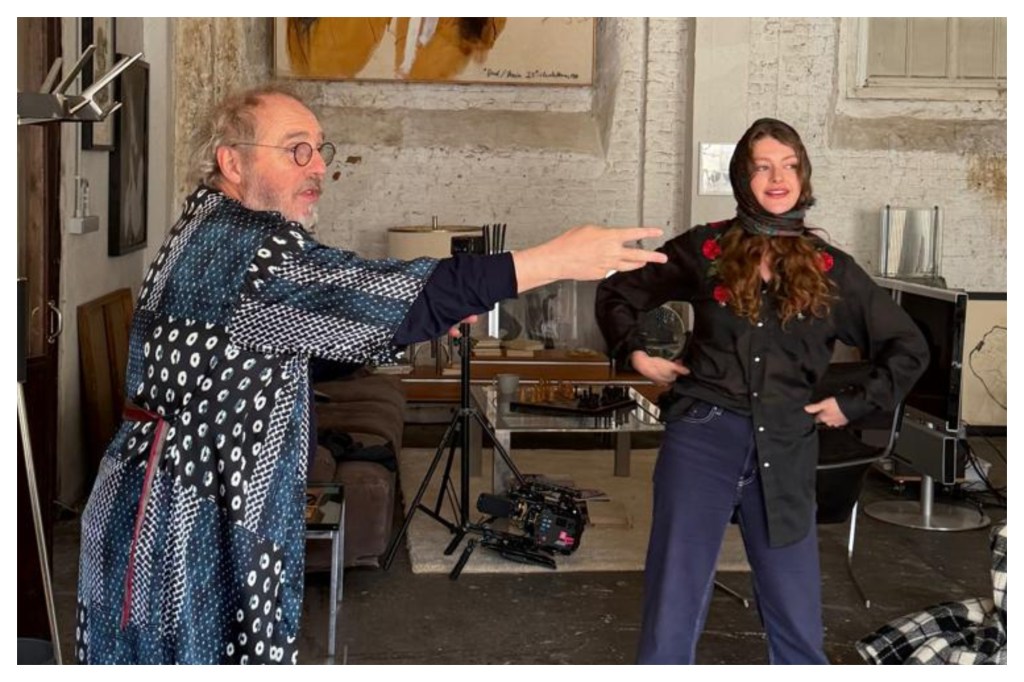
EXCLUSIVE: Cannes habitué Arnaud Desplechin is not at the festival this year but his upcoming English-language production The Thing That Hurts is making a big splash at the market with Gravel Lake Entertainment.
Featuring Alfre Woodard, J.K. Simmons, Jason Schwartzman, André Holland, Noémie Merlant, Golshifteh Farahani, Teddie Allen, and Felicity Jones in the cast, the picture is Desplechin’s starriest yet.
It revolves around the clients of a renowned American psychoanalyst who descend on Paris on the news of her death, causing unexpected connections and long-buried truths to come to the surface as their stories intertwine.
The film marks a departure for the the director on a number of fronts, with Daya Fernandez, Amaury Nolasco and Alois Rubenbauer at Puerto Rico-based 3SIX9 Studios producing his work for the first time, alongside French producer Charles Gillibert at CG Cinema, who produced his penultimate feature Filmlovers!, Atilla Yücer at Turkey’s Alaz Film and Belgium’s Wrong Men.
Written by Kamen Velkovsky and Desplechin, the film is executive produced by Wes Anderson and financed by Silver Screen Global.
Deadline caught up with Desplechin the film launches in the market in Cannes.

Arnaud Desplechin
Jane Owen Public Relations
DEADLINE: How did you get involved in this film?
ARNAUD DESPLECHIN: I was born to make this film. For over 30 years I’ve been reading about psychoanalysts, visiting shrinks, and talking about it with friends. It was a pitch that was proposed to me by Kamen Velkovsky, with whom I wrote Two Pianos, but this time we were writing in English. He writes beautifully. To that point, J.K. Simmons said, “How can I say no to such a well-written script?” That was Kamen.
People have often asked me, when I made, My Sex Life… Or How I Got Into An Argument, or A Christmas Tale, for example, “When are you going to make a real comedy?” Well, here it is. It’s a comedy, a bittersweet comedy.
The beauty of it is that it’s an ensemble piece, like A Christmas Tale, and each character has their individual adventure. It’s extremely funny, extremely melancholic, but it’s more funny than melancholic. A bit in the vein of Wes Anderson’s The Royal Tenenbaums which tells stories about things like incest, death, suicide, divorce, and so on, but you’re rolling with laughter throughout the film.
DEADLINE: Who plays the psychoanalyst at the heart of the story?
DESPLECHIN: It’s Alfre Woodard who is magnificent. It was bold of her to accept the role because she didn’t know Kamen or me, while my memories of her date back to Grand Canyon and Spike Lee’s Crooklyn. I also saw her more recently in a film called Clemency, which isn’t so well-known in the U.S. It’s an arthouse film in which she has real gravitas, an authority, which is truly wonderful.
DEADLINE: Did she know your work?
DESPLECHIN: I think her agent gave her some of my films but we didn’t really talk about it. As I said, I was born to make this film. It’s as if this is a first film. Nothing else counts. At the moment there is no before and after.
DEADLINE: The cast also features Felicity Jones…
DESPLECHIN: She is incredible, incredible. We’ve recently seen her in The Brutalist, in a very, very tragic role. Here she’s in a comic role. I don’t want to spoil things, but one of her last lines in the film is “To Life”, “L’Chaim”. That’s the spirit of her character. She has another line I love, “When I sparkle, I will sparkle”
It’s a side of her we don’t know much about, her comedic side, or rather we knew about it from her earlier films, but we’re all marked by The Brutalist.
DEADLINE: It’s not the first time you’ve directed an English-speaking film. You also made Esther Khan and Jimmy P: Psychotherapy of a Plains Indian.
DESPLECHIN: I learned a lot on those films, particularly on Jimmy P. We made it under difficult conditions, but it still made it to Cannes. It’s a film that has its weaknesses but still touches me, particularly the performance of Benicio del Toro. I could see the weaknesses, and it was part of my process of learning how to make films.
DEADLINE: How did you prepare for this shoot?
DESPLECHIN: We did a lot of readings which led to changes and improvements in the script. We improvised things, challenged things and said, “No, this line isn’t funny enough, we have to find something better, we have to do better”. The final script was born in collaboration with the actors. It meant when I got to set, we were totally prepared.
DEADLINE: The story unfolds in Paris but given many of characters hail from the U.S., wouldn’t it have been easier to make the film somewhere like New York?
DESPLECHIN: No, because there’s one very contemporary aspect of the film, which resonates with me: they’re all expatriates, people living in a foreign country, and that’s why they talk to each other. Alfre’s character of the psychoanalyst is the most in exile of the entire film. She’s an African American and a New Yorker, who has chosen to settle in France and practice psychoanalysis in a very French way. You have Golshifteh’s character of this incredibly rebellious woman who comes from Iran. Noémie Merlant plays the only French person in the group, but we learn that she’s spent time in Japan. They’re all characters who are out of place.
DEADLINE: How do these characters interact on screen?
DESPLECHIN: What’s very beautiful in Alfre’s character is that she is very different with each of her patients. Each adventure reveals a different facet of her character. I called them my Seven Samurai on set… it reminds me a bit of Catherine Deneuve in A Christmas Tale in which she has very different relationships with each of her children. We filmed each adventure separately… but the final scenes when we had them altogether they was very technically demanding and they were so generous, it was wonderful.
DEADLINE: How did Wes Anderson come on board as an executive producer?
DESPLECHIN: I’ve known Wes for a quite a long time. We met for the first time at a screening in France of Darjeeling Limited, a film I absolutely adore… Deep down I’ve always wanted to be a critic… I presented the film and explained why I loved it… and a strong friendship was born… but it was Atilla Yücer [Alaz Film] who knew him from Asteroid City who asked him if he would like to come on board as executive producer, I would never have dared, and it came together from there.
DEADLINE: How did you connect with the producers?
DESPLECHIN. I’ve worked with Charles Gillibert before, on my film Filmlovers!, while Atilla worked on the Jim Jarmusch film that Charles co-produced [Father Mother Sister Brother]. In France, everyone read the screenplay, but it was Charles who really got behind it and said he thought it was the best screenplay I’d ever written and had to be made. He was extremely tenacious in getting it off the ground. Because its English, the French system didn’t really work. It was when we found American funding, thanks to 3SIX9, that the film suddenly became possible. Atilla and Kamen met with Daya, Amaury and Al and got them to read the script and it turned out that the Americans like the project more than the Europeans. Daya is on set with us every day. I’ve never seen anything like it. I’m from a European background, so the producer is never there.
DEADLINE: We’re seeing more and more Hollywood producers and talent coming to work in Europe. What do you think is going on?
DESPLECHIN: None of my films carry a political message, but I still have thoughts if not an opinion. I think with the political developments we’re seeing in the United States, the country is changing in a way that is irreversible. The country will never be the same again. After Trump’s second election, the country is already different.
We see the war in Iran right now, the controversies surrounding Greenland and ICE. It creates a climate of anxiety, which I see in my American friends. They see their country as the world’s largest democracy and that is changing, evolving, and in flux.
It’s one of the themes explored in the film: all these characters are refugees in a way in France. And at the end of the film, it’s very beautiful, J.K. Simmons says, “Well, the psychoanalyst I loved died, so I’m going back to the United States.” And then all his friends say, “Are you crazy?!’ And he’s like, “F**k it, I’m going.” It’s my home.