


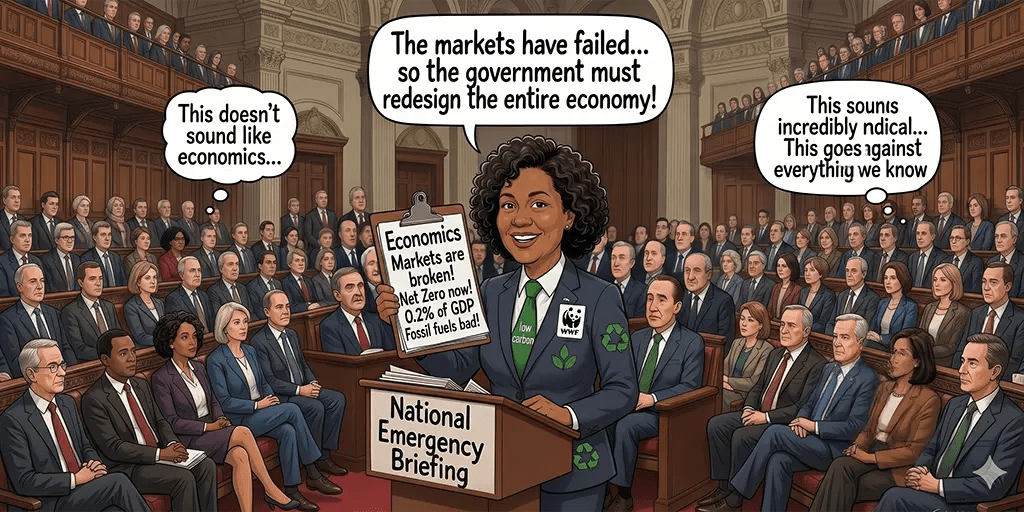
Last week, I wrote about I wrote about Tessa Khan, funded by European and American philanthropists, who uses the courts to impose Net Zero policies voters have rejected at the ballot box. She spoke at an invitation-only gathering of politicians, journalists and policy figures assembled at Westminster Central Hall last November.
This week, I turn my attention to one of her colleagues who spoke to the same invitation-only gathering of over 1,200 politicians and business leaders for the so-called National Emergency Briefing (NEB) — supposedly an “expert-led” briefing to address the UK’s “climate and energy crisis”.
The “briefing” event was supported by an array of organisations ranging from the National Trust and WWF to the National Education Union and the RSPB (Royal Society for the Protection of Birds). Of the 10 featured speakers, each introduced as a leading expert in their field, the slot for “economics” was given to Angela Francis, a self-styled “low carbon economist” and Director of Policy Solutions at WWF-UK. The audience, carefully selected, received her message with the reverence one might accord a scientific briefing.
This is a pattern that should by now be familiar to anyone who follows the climate-industrial complex in the United Kingdom. A convener with activist credentials assembles a sympathetic audience, presents a line-up of credentialled speakers and proceeds to make policy advocacy sound like dispassionate expert testimony. The format — emergency briefing, Westminster — is chosen for its associations with urgency and authority. What it actually delivers is something rather different: a well-rehearsed set of green talking points dressed in the language of economics, presented to people who will not ask inconvenient questions because they have not been invited to do so.
The accountant turned green economist
What are Francis’s qualifications? Her biography, as it appears on the NEB website and elsewhere, follows a well-trodden path. She began her career as an accountant in the energy industry before pivoting into what she describes as “economic development”, working for the East of England Development Agency and the consultancy SQW on productivity and “low-carbon growth”. She served as regional economist and climate attaché for the Foreign and Commonwealth Office in the Caribbean. She then became chief economist at Green Alliance, a prominent environmental advocacy organisation, before moving to WWF, where she now leads on climate, trade and industrial policy. Francis – like her fellow travellers in the big government climate bandwagon Mariana Mazzucato and Thomas Picketty — operates in a familiar tradition: the economist-as-advocate whose output is less an analysis of trade-offs than a brief for a predetermined conclusion.
Several things are worth noting about Francis’s professional trajectory. First, the Green Alliance is not a research institution. It is a lobbying organisation whose explicit mission is to advocate green policies. Her title there was chief economist, but her role was to make “the economic case for a low carbon and circular economy” — that is, to produce analysis in support of a conclusion that had already been reached. This is a species of work that often travels under the name of economics but one searches in vain for the principles of economics at work. The same is true of her current position at WWF, which is, whatever one thinks of its conservationist work, an advocacy organisation with a defined mission to advance Net Zero and nature-positive policies.
Second, her public biography reference does not include any graduate training in economic theory or quantitative methods. She has, over a 20-year career, worked at the intersection of advocacy and policy, with little economics in between. This does not disqualify her views from consideration. But it is worth holding in mind when she is introduced — and when she introduces herself — as an “economics expert” giving a “briefing” to parliamentarians and business leaders at Westminster Central Hall.
The bad arguments, examined
Let us examine what Francis actually said at the NEB, drawing on the published transcript of her remarks.
Her first major claim is that markets are, in her words, “broken” because they “take for granted a stable climate, clean air, fresh water, pollinators” — and that fixing this requires government to “set new rules of the game”. This is, on the face of it, a version of the standard Pigouvian argument about negative externalities: that pollution imposes costs on third parties not captured in market prices, and that corrective taxes or regulation can in principle address this. The argument is not wrong as far as it goes. Mainstream economics has for a century recognised that pollution constitutes a market failure, and that governments can legitimately intervene to price it.
But Francis elides something important. The standard Pigouvian toolkit — targeted taxes on specific pollutants, tradeable emission permits, the correction of discrete negative externalities — is a very different thing from the wholesale rewriting of market rules to mandate a Net Zero economy. The former is orthodox economics; the latter is a dirigiste programme of industrial transformation whose costs and unintended consequences are, to put it mildly, not trivial. The rhetorical move — from ‘markets have failures’ to ‘therefore government must redesign the entire economy in line with green objectives’ — is not an exercise in economic analysis. It is a political programme dressed up as a logical deduction.
Furthermore, the claim that CO₂ is straightforwardly a ‘pollutant’ in the same category as sulphur dioxide, nitrogen oxides or particulate matter deserves more scrutiny than Francis gives it. As both the Princeton physicist William Happer and the CO₂ Coalition have extensively documented, carbon dioxide is not toxic, does not damage lung tissue, and is — as any plant biologist will confirm — an essential input to photosynthesis. The economic case for taxing or restricting CO₂ rests on its hypothesied effect on global mean temperature over decadal timescales — a genuinely complex, highly uncertain and contested matter — not on any direct toxicological harm. Treating it as analogous to lead or mercury in the air reflects advocacy framing, not careful economic reasoning.
On costs: the ‘affordable’ Net Zero
Francis devotes considerable energy to rebutting what she calls the “bad argument” that the UK cannot afford Net Zero. Her central claim is that the investment required to stay on the Climate Change Committee’s (CCC) balanced pathway amounts to approximately £4 billion per year — roughly 0.2% of GDP — and that this cost is modest, largely fundable by the private sector, and “pays back” from 2041 onward. She also cites research from the Oxford Martin School and the Smith School to the effect that a rapid energy transition saves $12 trillion globally compared to staying on fossil fuels.
These figures deserve serious scrutiny, because they are far more contested than Francis implies. The CCC’s own estimates of the cost of the Net Zero transition have been revised upward repeatedly. Analysis by David Turver and others such as Dieter Helms – often called Britain’s leading energy economist — have argued that the full system costs of replacing dispatchable fossil fuel generation with intermittent renewables, including the necessary grid upgrades, backup capacity, storage and demand management, are substantially higher than official figures suggest. Germany, Europe’s largest economy and the country that pursued the green transition most aggressively in the previous decade, has seen industrial electricity prices rise to levels that have driven major manufacturers to shift production abroad or close domestic operations entirely.
The Oxford-Smith claim that ‘faster is cheaper’ deserves particular scepticism. This is a modelling result, and models are, as Francis herself acknowledges in passing, “simplifications”. They help answer specific questions, but they do not include everything. The specific model behind the $12 trillion figure — the FAST-Transition model developed at Oxford — has been criticised for assuming away the system integration costs of a rapid renewable build-out: the costs of intermittency, of stranded assets, of supply chain bottlenecks, of the social disruption attendant on rapid structural change. The claim that faster transition is cheaper is precisely the kind of result that sounds counterintuitive — and that should therefore prompt the question: what has the model left out?
The contrast with the mainstream of academic climate economics is instructive. Bjorn Lomborg, drawing on the work of Nobel laureate William Nordhaus and the integrated assessment models that Nordhaus pioneered, has consistently argued that the costs of aggressive near-term decarbonisation — particularly the 1.5°C and 2°C targets championed by the UN and the UK’s CCC — substantially exceed the benefits when properly discounted over time. Nordhaus’s own “optimal” carbon tax trajectory implies warming of around 3.5°C by the end of the century — well above the targets that Francis and the NEB treat as non-negotiable constraints. This is not fringe opinion: Nordhaus shared the 2018 Nobel Prize in Economics precisely for this work. The point is not that Nordhaus is certainly right and Francis certainly wrong. The point is that the academic literature contains serious, rigorous work pointing in a very different direction from the one Francis confidently sets out — and that literature goes entirely unacknowledged in her briefing.
On inflation and living standards
Perhaps the most arresting claim in Francis’s NEB talk is her assertion that the UK’s post-2022 inflation crisis would have been significantly mitigated had the country decarbonised earlier. Specifically, she argues that inflation would have been 7% lower with earlier power sector decarbonisation, 9% lower without the fossil-fuel link in food prices via fertiliser, and 11% lower with earlier heat pump adoption.
These are extraordinary numbers. They would, if true, represent the most compelling argument for rapid decarbonisation imaginable: not merely that it is allegedly good for the environment in the long run, but that it would have saved ordinary British households from several years of real income decline. But the empirical record points the other way. The UK and Germany, which have invested most heavily in renewable energy, saw some of the sharpest energy price increases in Europe when Russian gas supplies were curtailed — not because they had too much fossil fuel in their systems, but because they had dismantled too much dispatchable backup capacity and remained, at the margin, dependent on the gas price to balance their grids. The high fixed costs of renewable systems do not insulate consumers from price shocks; they merely change the nature of the exposure. And the intermittency problem — which Francis does not address — means that as renewable penetration rises, so does the need for expensive grid balancing services, ultimately paid for by consumers.
The NEB: emergency format, activist content
The NEB itself merits a word. It was founded and is run by the brothers Simon and Nick Oldridge, whom the organisation’s website describes as “climate funders and communicators with a background in business”. It is supported by WWF — Angela Francis’s employer — as well as the RSPB, the National Trust and a host of other environmental and civil society organisations. Its stated aim is “to inform every MP about the crisis” and to persuade the Government to stage a primetime televised emergency briefing on climate. An Early Day Motion was tabled in the House of Commons in May 2026 endorsing the NEB’s findings.
This is not a research institution. It is a lobbying initiative with the trappings of an expert briefing. The invocation of “emergency” is not a scientific judgement but a rhetorical choice — one designed to foreclose debate by suggesting that questioning the analysis is tantamount to recklessness in the face of imminent catastrophe. The format — ten experts, Westminster Central Hall, invited audience of the great and good — is engineered to produce precisely the kind of impression that Francis’s economics slot is designed to reinforce: that the case for rapid, comprehensive, government-directed green transformation is so overwhelming that it requires only briefing, not debate.
It is always Government’s job, as Francis herself concedes, to distinguish between the overall public interest and the interests of those lobbying most loudly. The NEB is lobbying, done with considerable sophistication. Independent scrutiny of its economic claims — the kind of critical engagement that a genuine parliamentary or academic forum would provide — is notably absent from its format. This is a design choice, not an oversight.
A note on epistemic humility
What the NEB’s economics slot does not offer is a serious engagement with those trade-offs. Francis presents a series of large numbers — £4 billion per year, $12 trillion saved, 0.2% of GDP — as if they were established facts rather than modelling outputs that are driven by implausible assumptions. And now we learn that the IPCC itself has ditched its extreme scenario (cast as “business as usual”).
She dismisses the counterarguments — that Net Zero is unaffordable, that the UK cannot act alone, that transition costs will raise the cost of living — as “bad arguments” and dispenses with each in a few sentences, without engaging with the substantial body of academic work that supports them. The audience at Westminster Central Hall was not in a position to push back. Parliament, the media and the public should be. The UK has no shortage of genuine economic expertise. It is past time to insist that it be brought to bear.
A version of this article was published in the Daily Sceptic https://dailysceptic.org/2026/06/19/yet-another-climate-activist-masquerading-as-an-economist/