


Natalie ShermanBusiness reporter
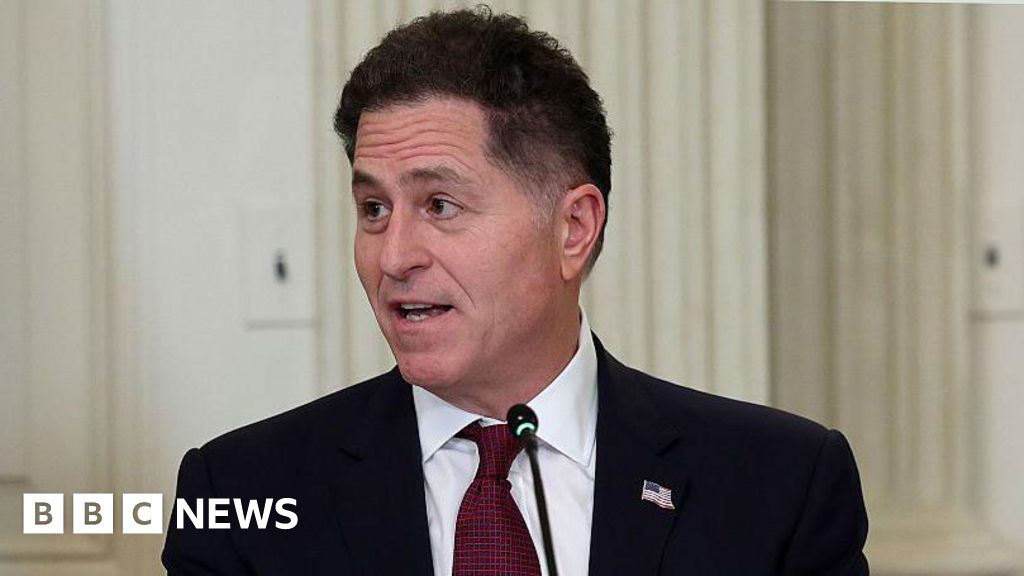
Tech billionaire Michael Dell and his wife, Susan, have announced plans to donate $250 to 25 million children across the US.
The $6.25bn (£4.72bn) gift will bolster Trump-branded investment accounts, which were authorised by Congress as part of its tax and spending bill earlier this year with the aim of encouraging families save for their children’s retirement.
As part of that scheme, babies born between 2025 and 2028 are also eligible to receive $1,000 from the government.
The Dells said their gift, which targets children age 10 and under, was intended to help seed those accounts and expand the savings opportunity to even more children.
“We’ve seen what happens when a child gets even a small financial headstart – their world expands,” Michael Dell said on Tuesday in a video on social media announcing the donation.
The money will be routed through the new Trump-branded accounts, which can be created for any child under age 18 and by law must be invested in a low-cost index fund that reflects the wider stock market.

 Getty Images
The Dells said children age 10 and under, who were born before 1 January 2025 were eligible for their gift, provided they live in areas where the median income is below $150,000.
The Dells said they expected the gift to reach almost 80% of children age 10 and under in the US. It is among the largest ever private donations to go directly to Americans.
Mr Dell, the chief executive of Dell Technologies with a fortune that Forbes estimates at almost $150bn, said he hoped other philanthropists and employers would make similar commitments.
“This will give middle class families a stake in American prosperity, a benefit from the rising stock market and a better shot at the American dream,” President Donald Trump said at an event celebrating the donation and the accounts at an event at the White House.
He added that children with the accounts would hopefully be “very rich someday”.
How Trump accounts work
The White House Council of Economic Advisers earlier this year estimated that $1,000 could grow to more than $5,800 over the course of 18 years, assuming a 10.3% rate of return.
Under the same scenario, $250 could grow to roughly $1,600, according to online calculators.
While it is not currently possible to set up a Trump account, the Treasury Department on Tuesday published a form that parents can use to establish them as part of the tax filing process.
It said more details about how the accounts would be administered would be available next year.
Parents are eligible to contribute up to $5,000 in funds to the accounts, a figure that will be adjusted for inflation. Employers, charitable organisations and others can also donate to the accounts, which are set to launch in July.
The child can access the money at age 18 at which point the account converts into a retirement account. While the money grows tax free, withdrawals are subject to taxes – and possibly a penalty if made before the age of 59 and a half.
The Trump accounts have met with significant scepticism from critics, who have argued that the accounts will primarily benefit better off families, who have extra money to set aside, while being less flexible than other, existing savings vehicles.
Treasury Secretary Scott Bessent drew criticism from Democrats earlier this year after promoting the programme as an alternative to government-funded retirement benefits, calling it a “backdoor to privatizing Social Security”.
The Tax Foundation, a think tank focused on tax policy, said that Trump accounts were “well intentioned” but would “add another layer to an already overcomplicated savings account system in the United States”.
“Trump Accounts do not offer much of an additional incentive to save,” it added. “Rather, the main benefit is in the form of the $1,000 initial deposit from the federal government and whatever employers choose to contribute.”
‘Free dollars on the table’
 Grayson Chester
New father Grayson Chester said that’s how he’s thinking about it.
The Seattle-area tax lawyer said other savings plans, like the education-focused 529s, seemed like better options for now. But that will not stop him from accepting $1,000 from the government.
“I will happily take $1,000 and I will happily keep it invested,” said the 35-year-old, whose first child was born two months ago. “As far as whether I would contribute my own dollars, that’s a hard one and I can’t see any advantages right now.”
But he noted that charitable donations like the one announced by the Dells, for which his son could be eligible, may make the progamme more attractive for parents like him. Dell Technologies is also among the employers pledging to make contributions to employees’ accounts.
“Anything that looks or feels like free dollars on the table will always make this worthwhile,” Mr Chester said.