


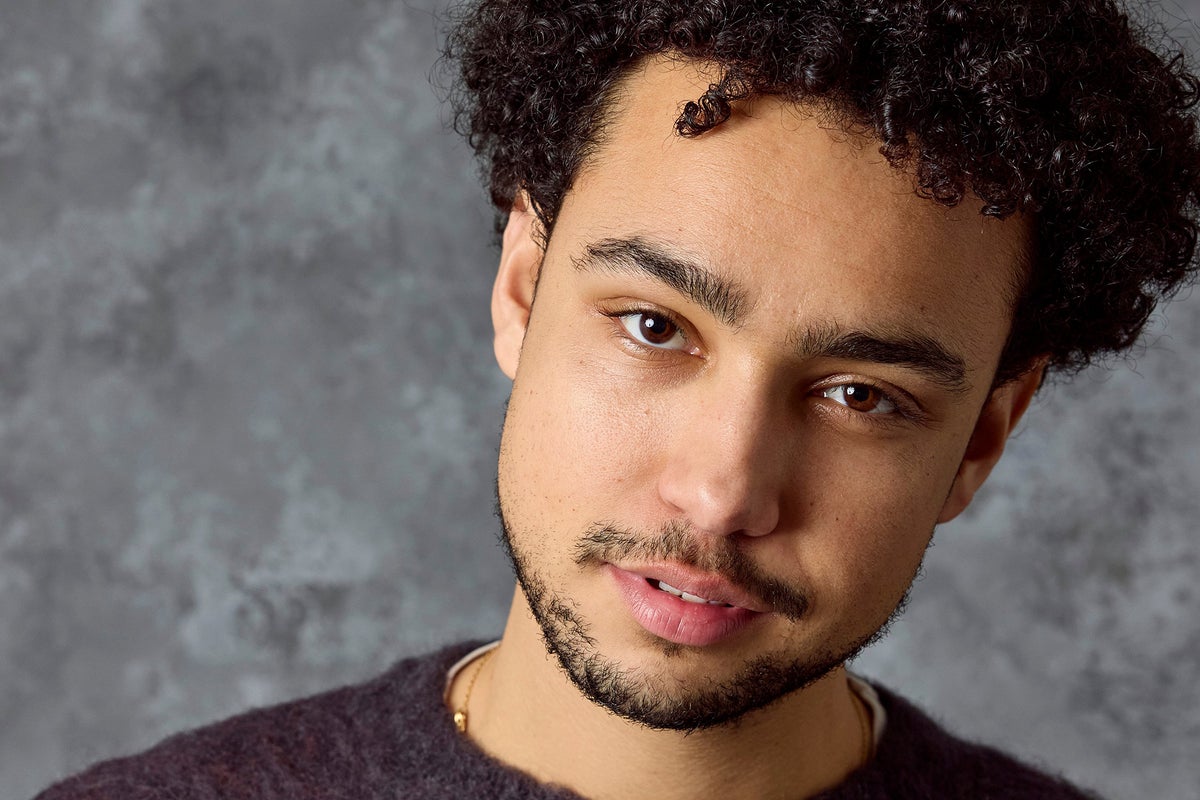
Before starring in Lurker, a thriller about the parasocial relationship between a rising pop star and a superfan, Archie Madekwe had a real-life lurker of his own. He was sitting in a coffee shop in LA one day, unaware that someone was watching him through the window. Alex Russell, the writer and first-time director behind the film, was sizing him up. “He just kind of watched me for a bit,” Madekwe tells me, now back in his native London. It was in this voyeuristic moment that he says the filmmaker was hit with the realisation: “I think he could play Oliver.”
Oliver is the mononym adopted by Madekwe’s charismatic British singer in the film, who lives in the Hollywood Hills with his entourage of hangers-on (“Trying to pass my friends off as professionals, man,” he laments in one early scene). A chance encounter brings him face to face with Matthew, played with reptilian precision by Théodore Pellerin, who poses as a casual acquaintance to ingratiate himself into Oliver’s orbit.
Madekwe, who’s six foot five and moonlights as a model for brands like Loewe, initially auditioned to play Matthew. It was “so scary and really intimidating” to instead be cast as the uber-confident musician, Madekwe tells me. “It feels a lot easier, or at least fills me with more confidence, to play somebody that’s more introverted, that’s recoiling,” he says, drawing his arms into his chest.
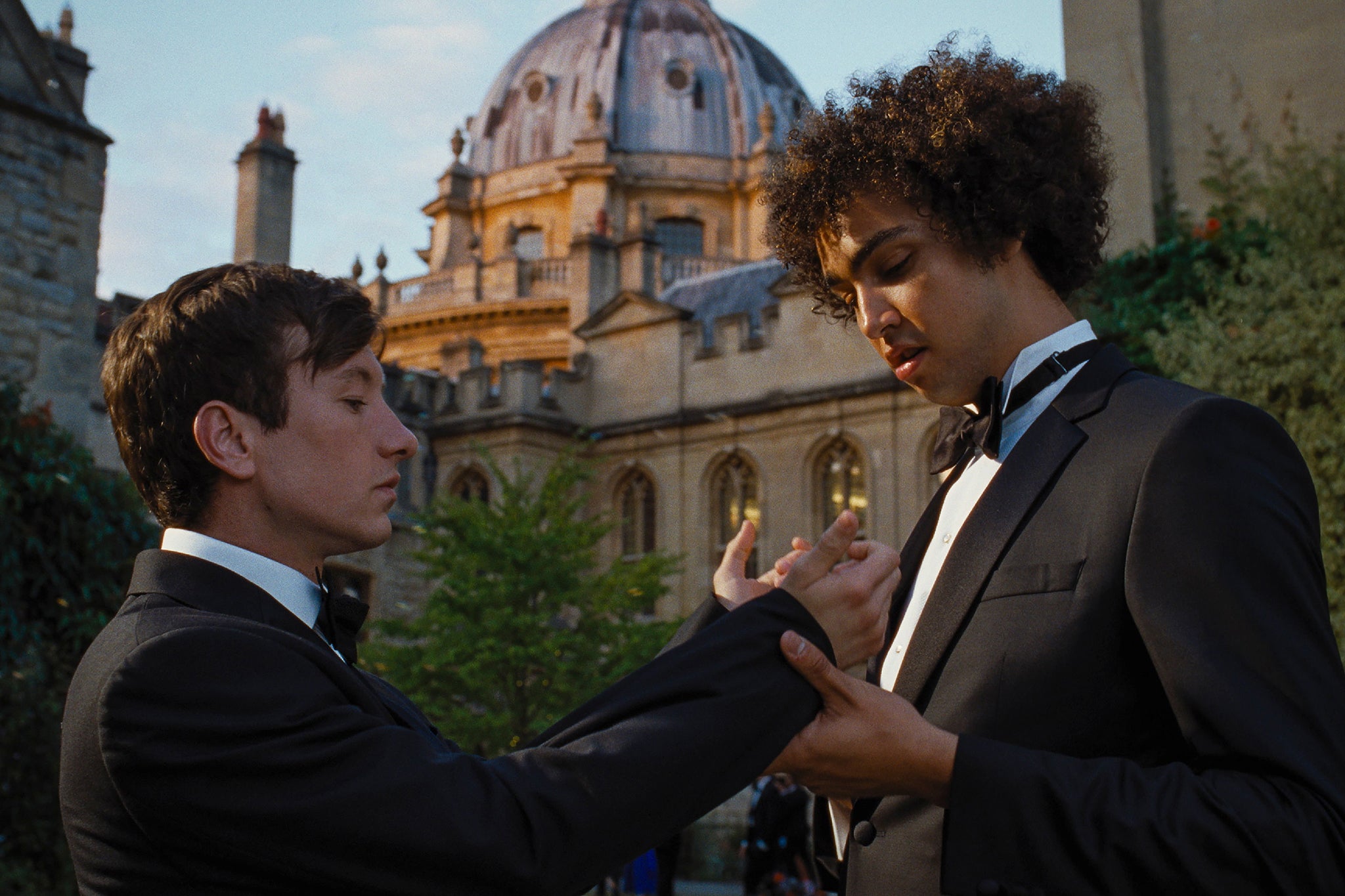
The 30-year-old’s star has been rising for some time now, thanks to roles in zeitgeist-y thrillers like Midsommar (2019), where he played an unwitting cult initiate, and Saltburn (2023) – he was Jacob Elordi’s louche Oxford pal. The Hollywood Reporter recently named him among their “8 Hottest Young Stars in Hollywood”. It doesn’t take a great leap to imagine that there must have been some parallels between Archie the movie star and Oliver the pop star, but Madekwe is having none of it.
“I think it’s actually just about perspective and headspace,” he says, pulling out a tight curl from his hair and twisting it before letting it spring back into place. “The difference between me and Oliver is, I’ve got all my friends from when I was a kid.” He’s seemingly forgotten that Oliver makes the same point in the film about his crew. “I’m really close with my family. I have a sense of grounding. That’s really important when you’re navigating this otherwise very destabilising world.” He says it’s “easy to get lost in the bigger picture”, and that’s when you fall into “narcissistic traits, or get kind of grandiose ideas of self. None of that stuff is real, but you have to be around people that remind you of that. Oliver doesn’t have that, but I, luckily, do.”
I wouldn’t call [the reaction] prudish. I do think that Emerald set out to shock and provoke. I think we probably knew that the film was taking leaps in fun and exciting ways
On ‘Saltburn’
That’s all well and good, but I remind him that in a recent interview with The New York Times, Pellerin let slip that Madekwe took him to Paris Hilton’s birthday party in Los Angeles before filming. Very down to earth! He grins sheepishly, then laughs. “Yeah… there definitely are aspects of life that are weird and random like that,” he says. It sounds like a very Oliver and Matthew experience, I tell him. “It definitely was, I think for Théo especially.” He says the two of them were at his house in LA, eating Thai food and watching Couples Therapy when the text came through about the heiress’s birthday bash. “Théo is like the antithesis of that,” Madekwe says. “He would much rather be in bed, in his pyjamas, reading a book, listening to some random flute player. I love him. He’s the most wholesome man in the world.”
Madekwe was born and raised in south London, to an English mother and a Nigerian-Swiss father. He followed his cousin, the Bafta-nominated County Lines actor Ashley Madekwe, to the Brit School before moving on to the London Academy of Music and Dramatic Art. He left early, having been cast in a West End play with Damian Lewis, before moving into film.
Saltburn was his breakthrough, and there are definite shades of Emerald Fennel’s provocative thriller in Lurker – both revolve around outsiders infiltrating the lives of the people they desire. Madekwe, though, believes any parallels they share lie in their shared conception during Covid. “I remember everyone talking about Saltburn being a film about what happens when you don’t get to touch the things you want to touch,” he says. “And I think that there is definitely a similarity between that and Lurker. There is definitely an idea of longing. And both these films are born out of a time where you had so much of that, where we were so cut off from the outside world.”

Fennel’s film – think Brideshead Revisited with more bodily fluids – sparked scandalised reactions from some corners upon release. In a recent interview, Jacob Elordi said he was surprised by how “prudish” the response was, grumbling: “I just think there’s far more extreme things in cinema that I’ve seen, far more graphic.” Madekwe doesn’t quite agree with his former co-star. “I wouldn’t call it prudish,” he says. “I do think that Emerald set out to shock and provoke. I think we probably knew that the film was taking leaps in fun and exciting ways. But if you can evoke a reaction like that with an audience where they’re physically moved and disgusted and feel like they have to turn something off, then that’s a win in my eyes.”
Lurker, Madekwe says, is the film he feels the “deepest connection” to. But the project that should have been his big-league breakthrough was the 2023 blockbuster Gran Turismo. It marked his first time at the top of the call sheet, playing a gamer turned racing prodigy opposite Hollywood heavyweights David Harbour and Orlando Bloom. Then the Sag-Aftra strike hit. The release was pushed back, the cast was barred from promoting it due to strike rules, and the film quietly underperformed at the box office despite warm reviews.
Before I can even finish asking how that felt, Madekwe cuts me off: “So frustrating. So frustrating. It was awful timing. [Sag’s] cause was so important. And yet there was this huge, mammoth…” He trails off. “The biggest opportunity I’d had in my career. And we weren’t allowed to talk about it.” Despite the circumstances, Madekwe is grateful for the experience of leading a big-budget production, even if it didn’t find the audience they were hoping for. “I got all of the lessons I think I needed as an actor for myself and my career out of it,” he says. “I grew so much, and so I’ll be forever grateful for it.”
It feels inevitable that similar opportunities will arise for the actor, who next stars opposite Sophie Turner in Steal, a new heist series coming to Prime Video. Turner is someone who, after eight seasons on Game of Thrones and a four-year marriage to Joe Jonas, has felt the more invasive effects of fame. Is it something Madekwe worries about?
“It doesn’t sit with me as a worry, because I think that would be so distracting or take up so much time,” he says. “The thing that is strange is the invasion of personal life or privacy.” He brings it back around to Lurker. “With parasocial relationships now, there is so much ownership that people have, and people love to make assumptions about people they don’t know; they have to fill in the blanks, and people forget that they are just human beings.” He sighs. “I try not to think about it too much.”
‘Lurker’ is in cinemas