


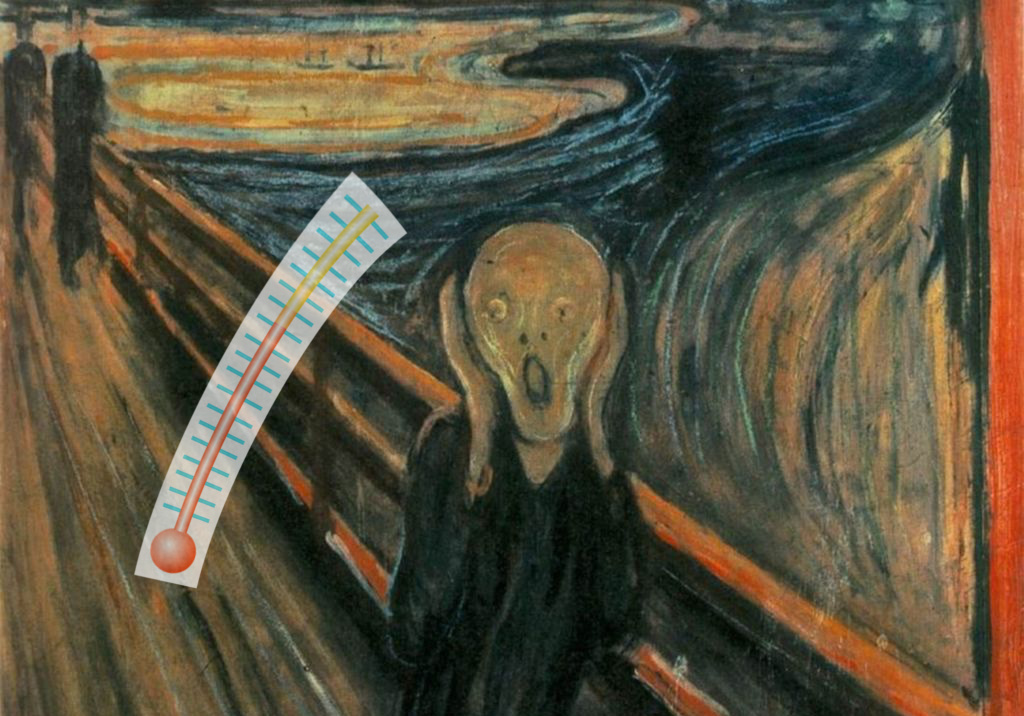
We just didn’t notice.
What to expect when you’re expecting the end of the world
Jem Bendell predicted that society would collapse because of climate change. Then he tried to get on with his life.
Jem Bendell had postponed his personal crisis long enough. For years, he’d been setting aside the worrying news about climate change he came across in a folder on his computer, waiting until he had the time (and emotional capacity) to look at it. In 2017, he took leave from his job as a professor of sustainability leadership at the University of Cumbria, in the United Kingdom, to finally dive in. …
… He’d just spent two decades arguing that businesses could help fix environmental problems and heal the flaws of capitalism …
…
The first thing to understand about the collapse of society is that the Hollywood version is wrong. Unlike the post-apocalyptic nightmare you’ve seen in movies, where everyone turns on each other in a moment of chaos and panic, civilizations don’t usually come to quick ends. Their falls happen gradually, over the course of decades or centuries, and might not have even been recognizable as a “collapse” to the people who lived through it. We could even be living through it now.
“To a historian, the fall of Rome may look like an obvious event in global history,” Luke Kemp writes in his recent book Goliath’s Curse: The History and Future of Societal Collapse. “To a peasant in Spain, it may have barely been perceptible.”
…
People in the Deep Adaptation movement, which expanded on its own without Bendell’s help, have been uniquely attuned to the signs of turmoil around them. …
…
Read more: https://grist.org/culture/jem-bendell-society-collapse-deep-adaptation-doom/
The abstract of the 2018 paper which appears to have started a global climate doomsday prepper movement;
Deep Adaptation: A Map for Navigating Climate Tragedy
…
Abstract
The purpose of this conceptual paper is to provide readers with an opportunity to reassess their work and life in the face of an inevitable near term social collapse due to climate change. The approach of the paper is to analyse recent studies on climate change and its implications for our ecosystems, economies and societies, as provided by academic journals and publications direct from research institutes. That synthesis leads to a conclusion there will be a near term collapse in society with serious ramifications for the lives of readers. The paper reviews some of the reasons why collapse-denial may exist, in particular, in the professions of sustainability research and practice, therefore leading to these arguments having been absent from these fields until now. The paper offers a new meta-framing of the implications for research, organisational practice, personal development and public policy, called the Deep Adaptation Agenda. Its key aspects of resilience, relinquishment and restorations are explained. This agenda does not seek to build on existing scholarship on “climate adaptation” as it is premised on the view that social collapse is now inevitable. The author believes this is one of the first papers in the sustainability management field to conclude that climate-induced societal collapse is now inevitable in the near term and therefore to invite scholars to explore the implications.
Read more: https://mahb.stanford.edu/wp-content/uploads/2018/08/deepadaptation.pdf
The hilarious part is by defining the collapse of society as imperceptible, the claims made by this climate prepper movement become unfalsifiable.
Aussie gasoline prices just hit AU $12 / gallon (for real). It must be a climate societal collapse, not stupid politicians killing Aussie domestic energy production in the name of a renewable energy pipe dream.
Future historians will marvel at this prepper movement in mind only – a prepper movement which mostly doesn’t actually prep, just keeps an eye on what they believe is the ongoing collapse.
Clearly the collapse of society hasn’t severed their internet connections, or reached the point where they all retire to their bunkers and seal the blast door. Let’s hope when the great withdrawal from society happens, they all forget to pay their internet bills.