


Steffan Messenger,Wales environment correspondentand
Gareth Bryer,BBC Wales

 Matthew Horwood/Getty Images
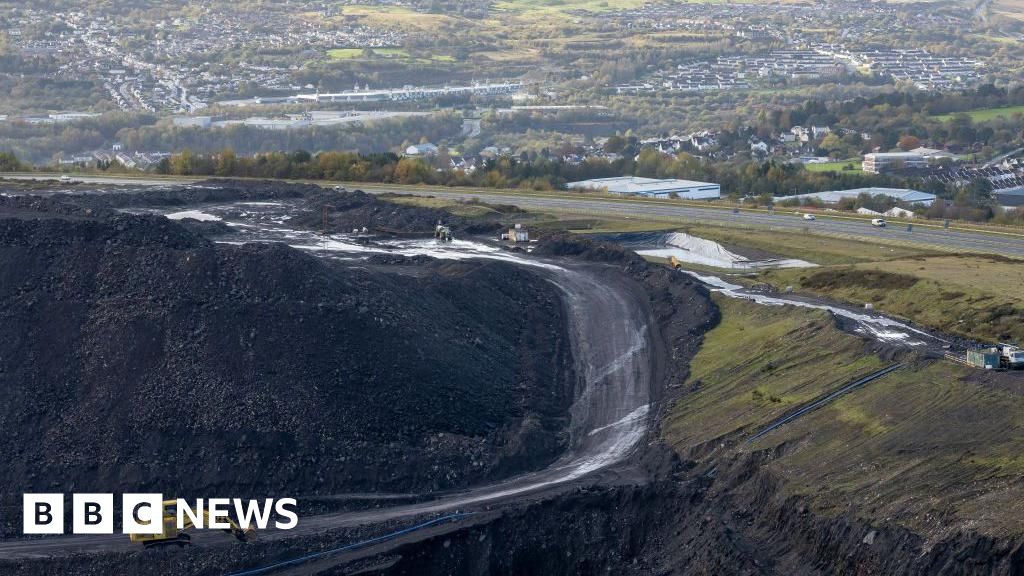
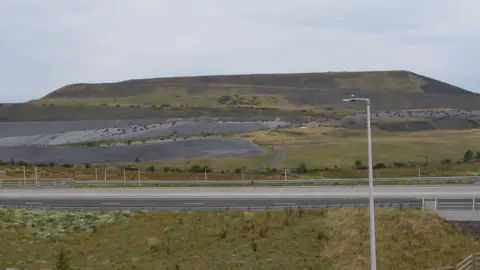
Concerns have been raised over the safety of three large spoil tips set to be left above Merthyr Tydfil following the closure of the UK’s last opencast coalmine.
A geotechnical report prepared for the council warns of a “significant risk of slope instability” from Ffos-y-Fran, while campaigners say plans to keep the tips in place are “staggering”.
Emails obtained by the BBC show the Welsh government is considering stepping in to take control over the final planning decision.
Mining firm Merthyr South Wales Ltd (MSW) said suggesting the “purpose-built, engineered structures” pose the same risks as historical coal tips is “incorrect and misleading”.
 Google
Two years since mining stopped at Ffos-y-Fran, there remains considerable uncertainty over the controversial project’s future.
Given the go-ahead back in 2005, the UK’s largest opencast mine was officially classed as a “land reclamation scheme”.
That meant part of the profits made from selling 11 million tonnes of coal over 15 years had to be used to clean up the site – riddled with the remains of old industries – and return it to green hillside for the community.
“It was supposed to be for public amenity, they were going to reinstate all the rights of way and agricultural use,” said Chris Austin, who lives nearby.
Now he fears the community will be left with “a dangerous void, dangerous tips and areas we can’t use”.
“It’s extremely worrying,” agreed Alyson Austin, Chris’ wife.
“We were forced to accept this opencast coalmine… now we’re left with a situation far worse than we had right back at the beginning.”
The current developers – MSW – had sparked anger locally and legal action after continuing to dig and sell coal for well over a year past the deadline on their planning permission.
They have since submitted a new – and far cheaper – restoration plan, warning of “insufficient funds” available to deliver what had previously been agreed.

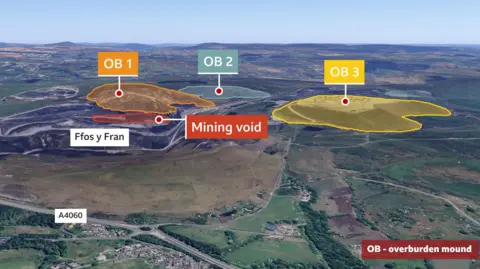
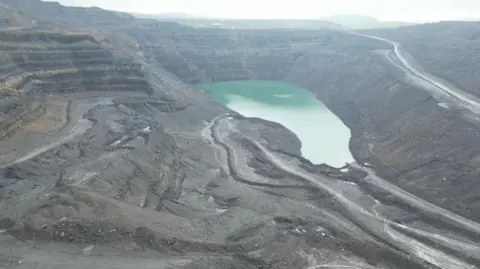
Under the original proposals, large spoil tips which had built up over the years would have been used to fill in the main mining void, which is 175m (574ft) deep.
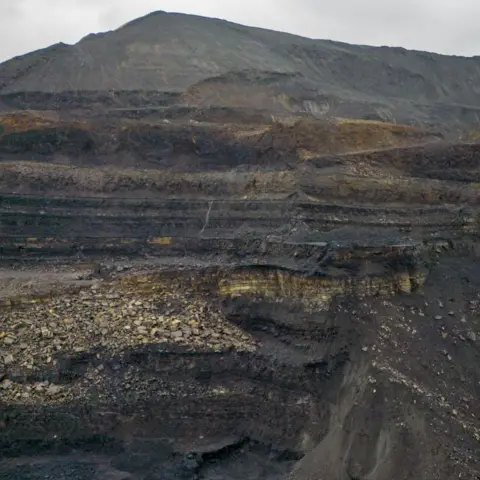
The tips – known as overburden mounds – contain 37 million cubic metres of material removed while the opencast mine was operating.
The company now wants to reduce the height of one tip while leaving the other two in place.
It describes them as long-term stable structures and says the mining void itself would become a “natural lake“.
The application is being considered by planners at Merthyr Tydfil council, who commissioned a geotechnical report from engineering firm WSP.
That document concludes that the tips were constructed as “temporary earthworks” and the proposals “do not provide confidence that the tips and slopes will remain stable and will not pose an ongoing risk to the residents of Merthyr Tydfil and a potential financial burden [to the council]”.
The effect of climate change “does not appear to have been considered” – while in some cases it is “dismissed with no supporting evidence”, the consultants warn.
They also note that one of the tips – known as OB1 – which rises approximately 170m above a main road running alongside Ffos-y-Fran – had already suffered a landslide in 2022.
The report also notes “the recent history of a number of tip failures across south Wales as a result of high rainfall events”.
Delyth Jewell, Plaid Cymru’s climate spokesperson, warned the residents of Merthyr Tydfil faced having to live with “a botched restoration” and said leaving the tips in place would be “staggering” and “unconscionable”.
“Coal tips slipping – this is not a theoretical risk,” she said.
The Welsh government has recently announced a new Disused Tips Authority for Wales, set up in the wake of concerns over the country’s coal tips, to be headquartered in Merthyr Tydfil.
Haf Elgar, director of Friends of the Earth Cymru, warned it could now end up having to add Ffos-y-Fran’s overburden mounds to its list of sites to monitor.
“That’s an added burden on public authorities and totally unacceptable,” she said.
 Matthew Horwood/Getty Images
In a letter to the council, consultants on behalf of MSW said they had “serious concerns” about the geotechnical report, which they branded a “desk-top assessment”.
They responded by commissioning their own analysis from geological and mining consultancy James Associates, countering WSP’s conclusions as to the tips’ stability.
It says the overburden mounds were constructed to an approved design in compliance with regulations and had been monitored by a specialist.
The landslide on OB1 had happened as a result of excavation work, and the likelihood of it failing in future could be “absolutely minimised” with appropriate engineering, it said.
Referring to recent landslides from old colliery tips in south Wales was “a case of comparing ‘apples and pears'”, the mine’s consultants added.
Generally colliery tips were located on steep hillsides, whereas Ffos-y-Fran’s overburden mounds sit “on ground with gentle gradients”, with differences too in terms of how they were constructed and their drainage systems, they said.
The company also makes the case that its new proposals are more sustainable, cutting down on carbon emissions and air pollution from the heavy machinery needed to reprofile the land while delivering “a more interesting and naturally biodiverse landscape”.
How much would it cost to restore Ffos-y-Fran?
Estimates vary as to how much removing the tips and filling the void would cost, ranging from £50m to £175m.
“The most recently published company accounts… (March 2025) include provision of some £91.2m for meeting the requirements of the approved restoration scheme,” the council notes in a recent letter to the firm.
But there now “appears to be a reliance” on the company using funds from a £15m account set up jointly with the council as a backup in case the firm went bust.
The mine’s consultants respond, saying detailed costings “are currently being prepared”.
 Chris Austin
Last year the Senedd’s environment committee described oversight of Ffos-y-Fran coalmine as “a case of epic mismanagement“, which now threatened to leave “a permanent scar” above Merthyr Tydfil.
Campaigners have urged the Welsh government to take over the decision-making process.
But in emails, officials noted “the possible consequences of such action, including the risk of site abandonment”.
They had written to the council in August requesting further information.
“Given the level of risk… we are mindful of the need to ensure we provide a robust evidence base to the Welsh ministers to underpin any options they may wish to pursue,” the email says.
Ms Jewell, a Senedd member for South East Wales, said the Welsh government had a “moral obligation to the safety of the residents of Merthyr Tydfil” and should intervene.
In a statement Merthyr South Wales Ltd said it was “particularly disappointed” by Ms Jewell’s comments, which they said risked “undermining confidence in the planning system by introducing political pressure into what must remain an evidence-based determination”.
“Merthyr South Wales Ltd remains fully committed to cooperating with the planning authority and has every confidence that the application will be determined lawfully, impartially, and based on professionally verified facts, records and recommendations,” it said.
The council said it would undertake a further consultation once it receives extra information from the developer.
The Welsh government said it was working with the council and other partners “to ensure the best possible outcome is achieved for local people”, and said the case remained “under active consideration for call-in by the Welsh ministers”.