


By P Gosselin on 10. May 2026
Another sign that the “Green” Revolution is sinking Germany
The Energiewende (transition to green energy) is often hailed as the future of urban logistics, but a recent development in Bielefeld, Germany, serves as a sobering cautionary tale. The city has been forced to mothball its entire fleet of seven hydrogen-powered garbage trucks.

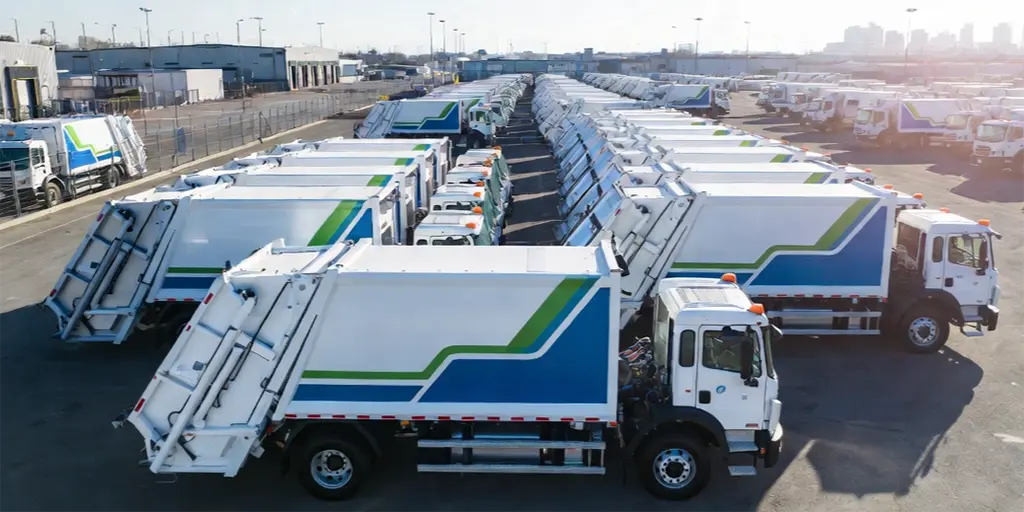
Idled garbage trucks. Illustration image only, generated by Grok AI.
Poor logistics
Blackout News reports that for years, Bielefeld’s hydrogen trucks relied on a refueling station in Rheda-Wiedenbrück. Even then, the logistics were strained; drivers had to make an 80-kilometer round trip just to fuel up. Given that these trucks have a daily range of about 300 kilometers, nearly a third of their energy was being spent just getting to the pump.
When the station in Rheda-Wiedenbrück closed, the situation turned from difficult to impossible. The next available station was in Münster—roughly 180 kilometers away for a round trip. At that distance, the trucks would consume most of their fuel just traveling to and from the station, leaving virtually no range left to actually collect trash.
Massive financial investment
The scale of idling the buses is significant. Each of the hydrogen-powered trucks cost approximately €1 million—four times the price of a conventional diesel garbage truck (roughly €250,000).
To bridge the cost gap, the German federal government provided massive subsidies, covering 90% of the additional costs. In total, nearly €5 million in taxpayer money was pumped into this fleet. Today, those high-tech vehicles are now idle, doing nothing, representing a massive waste of subsidized resources.
Bureaucratic absurdity
The most frustrating part of the story is that Bielefeld actually has a hydrogen refueling station within the city. One might think the solution is simple: just refuel the trucks at the local station! However, due to the strict terms of the government subsidies used to build that station, its use is contractually restricted to hydrogen buses only. Despite both the buses and the garbage trucks belonging to the municipal fleet, formal funding rules prevent the trucks from using the local pump.
Trend of hydrogen snafus
Bielefeld isn’t an isolated case. Similar issues have been reported in Duisburg and Lübeck, where hydrogen-powered municipal vehicles have been sidelined due to fuel shortages or infrastructure gaps. It highlights a recurring theme in the “Energiewende” (energy transition): technology is often deployed far ahead of the practical infrastructure needed to support it.
Summary
The case of Bielefeld’s idle garbage truck fleet is an example of bureaucracy’s rank inability to operate a society, serving as a reminder that “green” technology is a costly folly.
Original report in German at Blackout News here.