


By Stephen Heins, The Word Merchant, Sheboygan, Wisconsin
Out here in America’s heartland, where families have worked the same land for generations, we understand a basic truth: real stewardship comes from people who live close to the ground, not from distant offices in Washington issuing one-size-fits-all rules. The U.S. Fish and Wildlife Service’s finalization of Endangered Species Act regulation reforms under Secretary Doug Burgum delivers exactly that kind of correction.
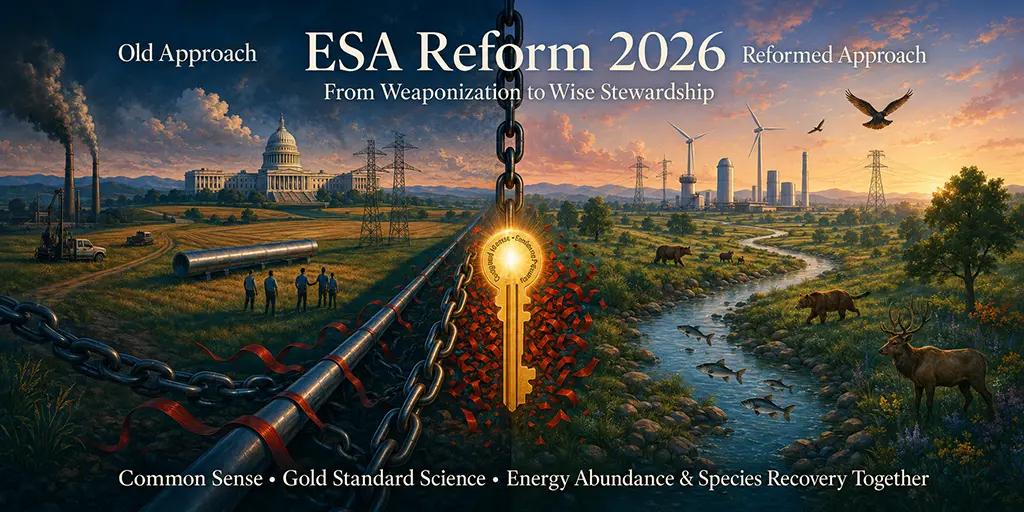
It returns the law to its original intent, applies Gold Standard Science and common sense, and reins in the activist overreach that turned the ESA into a blunt instrument for blocking projects and controlling economic activity.
These changes matter. The EPA has eliminated the burdensome “blanket rule” created in the final months of the prior administration. That rule wrongly treated every “threatened” species as if it were “endangered” by default, imposing the strictest protections unless a specific exception was carved out. In the future, a threatened species will be treated as such, with tailored 4(d) rules that reflect each species’ biology and circumstances.
This is precise protection, not ideological overkill.
The reforms also fix the critical habitat designation process. The law now requires proper consideration of economic impacts, national security, and other relevant factors. Areas can be excluded from critical habitat if that exclusion will not cause the species to go extinct. This prevents the previous practice of drawing lines on maps that ignored the human and economic costs while pretending every designation was purely scientific.
Secretary Burgum stated it plainly: “For too long, the Endangered Species Act has been weaponized to stop almost any new project in America, driving up costs for families, weakening our competitiveness, and undermining our national security.” He also noted the dismal results: nearly 97 percent of species ever placed on the list remain there today.
Success under the ESA should be measured by recovery and delisting, not by the growing length of the list or the number of projects delayed or killed through litigation and regulatory gamesmanship.
Multi-generational families on working lands care deeply about wildlife, clean air, clean water, and healthy habitat. They have always been the front lines of actual conservation. These reforms trust those voices and the states that know their lands best. They replace top-down, one-size-fits-all regulatory decisions made in Washington with site-specific, species-specific, data-driven approaches that relieve unnecessary financial burdens on ordinary citizens.
This is a direct step toward ending the reckless use of environmental regulation by the Green Industrial Community as a tool to control the economy, energy development, and the environment itself. When rules become weapons to stop pipelines, mining for critical minerals, power plants, or infrastructure under the banner of species protection, the result is higher energy costs, large lost jobs in places like Wisconsin and across rural America, weakened energy independence, and often poorer conservation outcomes because resources get tied up in endless processes instead of focused recovery work.
The false premises and selective ideology that plagued implementation for years are being corrected. Environmental protections should apply based on real threats and real science, not on which species or which projects fit a preferred narrative. Balanced, lawful administration serves both wildlife and the working families who depend on reliable, affordable energy and economic opportunity.
Secretary Burgum’s directive to strengthen American energy independence, improve regulatory predictability, and align federal actions with the best reading of the law is being followed. Service Director Brian Nesvik captured the right spirit. In the 21st century, the agency will embrace a data-driven approach while recognizing the American people’s ability to prosper in the land of the free. These revised regulations open the door to a more cooperative relationship between regulators, federal government, conservationists and the citizens they serve.
We in the heartland have long argued that genuine environmental progress flows from human flourishing, not from policies that punish abundance. Prosperous, energy-secure communities have the means and the incentive to invest in cleaner technologies, better habitat management, forest management,and actual species recovery. Regulatory regimes designed primarily to constrain economic activity and energy production achieve the opposite: they raise costs, slow innovation, and breed resentment toward conservation itself.
These ESA reforms are a welcome return to the successful framework established during the first Trump administration. They enhance transparency, clarity, predictability, and efficiency while staying faithful to the statute’s purposes. They lower costs for American families and position more species for genuine recovery and delisting. That is something worth celebrating.
Final Thoughts on These Reforms
• Original legislative intent must control implementation. Activist expansions that turn statutes into open-ended tools for stopping development erode both the law and public confidence.
• Decisions belong closest to the ground. States, local communities, regions, and multi-generational families who live and work the land are better stewards than distant bureaucrats applying uniform national rules.
• Economic impacts and national security are not secondary considerations; they are essential to any sustainable policy that serves real people in real places.
• Success is measured by species recovery and delisting, not by the size of the list, the volume of litigation, or the number of projects blocked.
• Gold Standard Science and site-specific analysis beat ideological one-size-fits-all mandates every time.
• Human prosperity and energy abundance enable better environmental outcomes. Regulations crafted primarily to control economic activity and energy production are self-defeating and ultimately anti-humanist.
This is common-sense reform done right. The heartland agrees.