


The trajectory of Backrooms director Kane Parsons’ life over the last 16 months is something most people couldn’t wrap their minds around. Releasing the last weekend of May, his eerie psychological thriller, shot for under $10 million, went on to earn just under $400 million in theaters, split almost exactly evenly between the United States and international territories — making it distributor A24’s highest-grossing film of all time. For Parsons, still just 21 years old (and barely 20 at the time of his movie’s shooting in the summer of 2025), it marked a stunning affirmation of filmmaking instincts.
Still, huge, outsized commercial success — and even a zeitgeist-tapping triumph — doesn’t necessarily always translate into a sustained, popular directorial career: witness something like The Blair Witch Project, if one doubts. But talking with Parsons, it becomes clear in a matter of moments that the success of Backrooms is no fluke, or overachievement in marketing. Whip-smart, and fluent in both the technical and narrative languages of cinema, he possesses all the requisite tools for occupational longevity, potentially minting him as a generational talent.

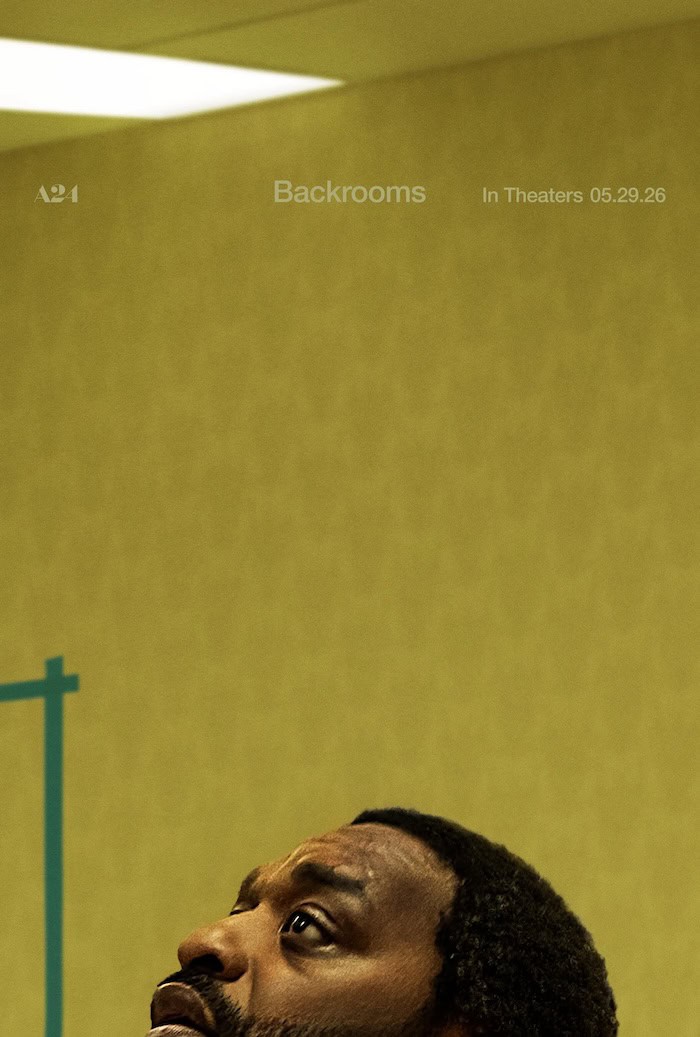
Based on Parsons’ YouTube web series of the same name, which was in turn inspired by various internet message board and online platform explorations of liminal spaces, and adapted into a screenplay by Will Soodik, Backrooms tells the story of Clark (Chiwetel Ejiofor), a failed architect and unhappy furniture store owner in San Jose, California, who finds himself coping with disillusionment and a crumbling marriage. Sleeping in his store, Clark one night goes downstairs to the storage area, and discovers an extradimensional space — at once dizzyingly complex and incredibly mundane — lit in queasy, fluorescent fashion, and populated with stacked furniture and sloped ramp-ways.
When Clark tells his therapist Mary (Renate Reinsve), who herself harbors some childhood trauma still front-of-mind, she initially doesn’t believe him. Clark becomes fixated on mapping the area, and enlists his assistant manager Kat (Lukita Maxwell) and her boyfriend Bobby (Finn Bennett) to help him. After Clark no-shows for an appointment and Mary receives a cryptic message from him, though, she visits his store, and enters the backrooms herself, plunging herself (and viewers) into a deeper mystery with no pat answers.

Recently, Brent Simon had an opportunity to participate in a virtual press conference with Parsons, and reflect upon the production, themes, and enormous success of his film. Excerpts from the conversation, condensed for the sake of length and clarity, are as follows:
Question: I wanted to ask about ambiguity, because I think your perspective might be especially interesting. Liminal spaces as an online phenomenon are inherently tied to their ambiguous nature, and Backrooms embraces that as a film. Given your background as an online creator, I’m curious about the media you consume, both film and online. Do you find yourself leaning into ambiguity because it genuinely appeals to you, or is it more specific to this project?
Kane Parsons: I think I always lean into ambiguity. I came up mostly consuming online film projects, and like everyone else I’m seeing a lot of the same films — I don’t watch as many as some people, but I got into all of this through a pipeline that promotes real curiosity about the world I’m physically living in, beyond how you might process it through art. I’m always trying to find a roundabout way to process that stuff outside of any one pinned-down medium. In life you never get a summary at the end telling you what you got right and what you got wrong — that open-endedness is just true of being alive, and I think it makes ambiguity an ambient theme in everything I do. With a sci-fi construct as wild as the Backrooms, it feels reductive to think you’re going to get a pinned-down understanding that goes beyond what the characters have. So what I really go for are strong, well-researched guesses rather than concrete answers.
Question: Was moving to a feature film a limitation, or a chance to change the aesthetics?
Kane Parsons: It was a trade-off in some ways, but I wouldn’t call it a limitation — we were limited in some areas and gained in others. I’ve had to view Backrooms, and everything I do online, like a tree that’s growing: you can have branches that go into different worlds and different mediums. A lot of people online love the enigmatic logic-building of the YouTube series — understanding the system as a whole is part of the fun. Being able to focus in on a single emotional thread, with individual people colliding with that tree they’ve started to understand, and doing that within a more conventional 90-minute feature, was fairly self-explanatory in terms of what we were hoping to achieve emotionally. We also made peace with the fact that the goal here isn’t to include 25 minutes of a character walking down a single hallway just because it’s realistic. You can do that on YouTube, where people fast-forward and watch at their leisure, but in a concise, controlled theatrical runtime it’s better practice to manage the audience’s attention more deliberately. And obviously the resources were huge — we got to build the space for real. So in a lot of ways it was elevated.
Question: What’s the biggest lesson from those YouTube days that still shapes how you direct actors and tell stories on a Hollywood set?
Kane Parsons: I don’t know if I’d call it a lesson so much as a sensibility I enjoy practicing: I really like synthesizing the feeling of reality. Sometimes when you’re watching something that feels too out-there or too specific, it reads as though it must be drawing from something real — it’s hard to curate, but it feels like you’re capturing a living thing rather than something drafted out with schematics over and over. I like to find obscure details that are somehow universal to everyone, and then give them a lot of weight. Backrooms is such an architecturally centered film, and I think it connected with people who have formed profound, often unspoken relationships with the spaces they’ve inhabited — rooms from their childhood they haven’t thought about in 40 years. I’ve seen a lot of people say it sent their mind back to some wandering space. So the YouTube work encouraged that way of thinking, and now we’re transposing it with a more mature layer of character work on top.
Question: What do you think young directors like yourself understand about catching a Gen Z audience’s attention that older filmmakers or industry people might not?
Kane Parsons: Some of that is still to be determined, and it’s tricky, because everyone wants to capture it and sell it as a formula. So far, whatever ability I have to speak to those sensibilities comes mostly through intuition — subtle biases programmed into my brain by growing up with the internet. I can sometimes articulate them retroactively, but often the choices that get a response from people my age, with similar backgrounds, are things I don’t even realize I’m doing. What I will say is that habitually checking the comment section of whatever you’re looking at — which I do, and a lot of people do — probably builds a greater ability to predict the social-media fallout of a piece of art, for better or worse. So there may be more pre-programmed PR instinct in younger people’s brains simply because they’ve been steeped in that echo chamber growing up. But it depends on the person, and I’m still figuring that part out.
Question: Backrooms touches upon memory, grief, trauma. In what way were those personal themes for you, and was the film cathartic in any way?
Kane Parsons: I don’t like to define too heavily what the point of it was for me — I have my own readings, but I prefer to keep them to myself. I wouldn’t call it a “trauma film.” That was never the intention, even though a lot of films get bundled under that label these days. For me it was a way of processing the excuses we make as individual parts of the abstract systems we build — culturally, societally. A lot of those bigger systemic ideas are represented through the work Mary and Clark are doing in the film: where they are in their lives, the commercials they’re making, and what that signifies about where they sit economically in 1990s American culture. Even at the end, with Mark Duplass’ character, all the characters are orbiting the same void, trying to produce an answer out of something that’s essentially an endless singularity — you’re not going to get an answer. But they try, and they each find ways to make peace with it, or to fling themselves out of it into a life that’s productive for them. So it’s a meditation on what we defer and give up to the systems we inhabit.
Question: Did you consult a therapist or psychologist while exploring the subconscious of the Backrooms?
Kane Parsons: For foundational context, my mom is a therapist, so I get some of that by osmosis. And one of the producers’ partners is a therapist we spoke with a fair amount. In the film, part of what we were aiming for is that Renate’s character, Mary, isn’t necessarily a gold-standard therapist — there are ways in which therapy is done wrong, and that’s the specific version of therapy, at that point in time, we were looking at. As for the psychology of the Backrooms itself, I wouldn’t say it’s truly built on the memory logic that Clark describes in the film — those are things people attribute to it. It’s a blank canvas that soaks up whatever people throw at it: if you believe it makes things out of memories, there’s evidence that seems to point that way. There is a pseudoscientific system that explains everything, but the audience doesn’t get it — it’s just characters trying to reconcile it. So by necessity we needed a good handle on that. I generally enjoy knowing what I can, in an armchair way, about psychology, and we did have some consulting on the therapy side, plus I did a fair bit myself to make sure the overall logic was a sound, closed loop.
Question: One thing that surprised me is how many different audiences this film is reaching — teens, but also much older people, and even people who don’t usually like horror. When you first imagined the film, who did you see as the audience, and did you ever expect it to connect with such a wide range of people?
Kane Parsons: I never really pinned down an audience by age range — I try to be blind to a demographic. In some ways I make it for myself, hoping that people with similar fixations on abstract sci-fi devices, or on processing broader systemic elements of life through some supernatural container, will get excited about the same touch-points I nerd out over. I never really thought of the film in a horror context. I was aware it would be perceived and marketed that way, but I don’t experience it as a horror film, because the goal isn’t to scare or horrify so much as to evoke introspection — to interrogate certain relationships between people and the external world. Everyone takes what they’ll take from it, and it undeniably has its scare moments. But the core tenets already existed; it’s grounded in hard sci-fi logic wrapped in an unknowable, mysterious veneer with a nostalgic core. It does draw a lot of young people who are familiar with the property, but when you deconstruct the idea, it’s simply an architectural space that’s almost timeless — nothing about it inherently makes a young person’s experience more relevant. If anything, it works as a kind of time-travel device: a door beckoning toward a simpler, more tangible time in your life. For someone who’s hit some dead ends, it opens up a lot of possibilities to go back, or to find things they’ve long lost. So I don’t think it brought in a youthful audience purely on its own merits — that’s partly how the internet has played with the idea over the years — but it does seem to reach well beyond that.