


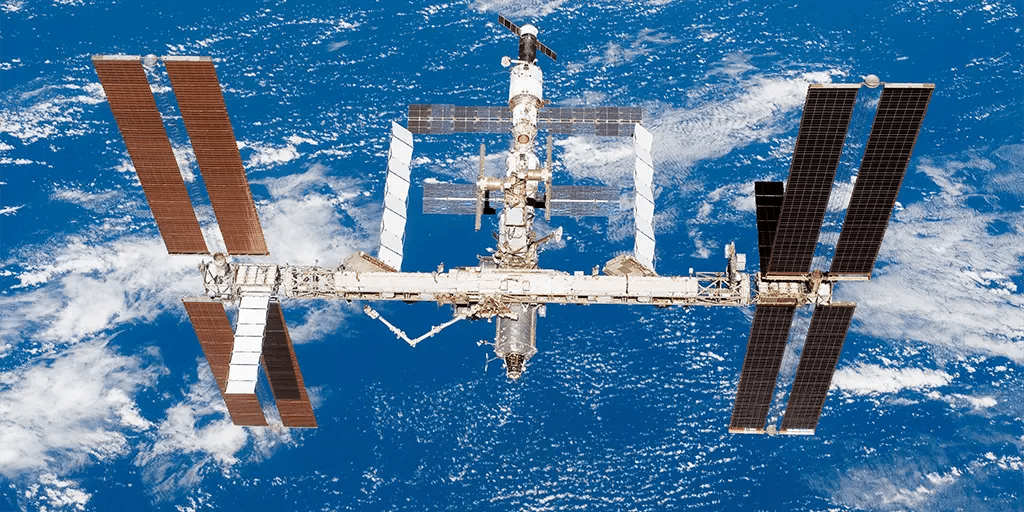
Five astronauts ordered to take shelter and prepare for evacuation for roughly two hours as Russian crew attempted to fix a crack on its portion of the orbital laboratory,
Posted by Leslie Eastman

NASA and Roscosmos are dealing with a worsening but still controlled air leak in the Russian Zvezda service module transfer tunnel (PrK) of the International Space Station (ISS).
The leak briefly prompted NASA to order astronauts into a docked Dragon spacecraft in case an evacuation became necessary.
Mission control in Houston radioed the station around 9 am EST (14:00 UTC) and sent four Crew-12 astronauts into SpaceX’s Crew Dragon Freedom: NASA’s Jessica Meir and Jack Hathaway, French astronaut Sophie Adenot, and Russian cosmonaut Andrey Fedyaev. The four launched on Crew-12 in February, and the capsule doubles as their lifeboat until their scheduled return to Earth in September. NASA astronaut Chris Williams, who reached the station aboard a Russian Soyuz, joined them inside the Dragon.
The call from the ground was direct. “All USOS (US Orbital Segment) crew members need to execute … Emergency Procedure 3.4: Crew Dragon, establish Safe Haven,” controllers told the crew. “If we need (you) to suit up, we will do that once we’re inside the Dragon.”
A worsening air leak aboard the International Space Station (ISS) prompted five astronauts to take shelter and prepare for evacuation for roughly two hours on Friday as Russia attempted to fix a crack on its portion of the orbital laboratory, according to NASA. pic.twitter.com/H4PmxSDf4A
— AstroNana (@ImAstroNana) June 7, 2026
However, operations returned to normal relatively quickly while crews continued repairs and monitoring.
NASA reversed that order roughly two hours later and told the astronauts they could return to the station as the agency and its Russian counterparts examined the rate of leaking air.
NASA and Russia’s space agency Roscosmos, the station’s two primary operators, have debated for months over the cause and potential fixes of small air leaks aboard Russia’s Zvezda service module, a key structure of the ISS, a football field-size orbital laboratory where astronauts live and work in space.
Roscosmos said on Friday that its experts had detected two leaks aboard the ISS but that there was no immediate threat to the crew. The first leak was quickly sealed, and preparations were underway to seal the second one, Roscosmos said, adding that there was no threat to the spacecraft’s systems.
Seven astronauts remain aboard ISS as repairs continue. Read more about what happened: https://t.co/3iNRs4Of5m pic.twitter.com/3CIMpNncLU
— Cybernews (@Cybernews) June 8, 2026
Engineers have traced the problem to microscopic cracks in the PrK structure, which have caused slow leaks of the station’s atmosphere since at least 2019, and have proven difficult to permanently seal.
Engineers believe the leaks are caused by microscopic cracks in the module’s structure. Russian cosmonauts have repeatedly inspected and attempted to seal the cracks, but a permanent fix has eluded them. After a few months of pressure stability inside the PrK earlier this year, Roscosmos confirmed in May that the air leaks had returned.
Roscosmos, Russia’s space agency, typically keeps the PrK sealed off from the rest of the space station to isolate the leak from the crew’s living quarters and workstations. This allows the transfer tunnel to be maintained at a lower pressure than the rest of the station. When cosmonauts need to access the area, such as for inspections, repairs, or transferring cargo to or from a docked Progress supply vessel, they pressurize the PrK to match the pressure inside the rest of the station. This allows the cosmonauts to open up the PrK to complete their work.
A statement posted by Roscosmos on its Telegram channel suggests this is what was happening early Friday. “Specialists from the Russian ISS segment’s main operations control team detected a leak in the chamber” during pressurization of the PrK.
…Russian and NASA officials also did not say what compelled Roscosmos to plan an immediate repair after discovering the two potential leak sites on Friday. They also did not say when cosmonauts might try again to patch the leak, or if any future repair effort might again force the US crew members to take shelter.
It’s a good thing that NASA plans to retire the ISS around 2030 using a specially built “space tug,” likely based on SpaceX’s Dragon spacecraft. The $1 billion plan involves a controlled deorbit that will send most of the 400‑ton complex burning up in the atmosphere and the remaining 40–100 tons into the remote Pacific “spacecraft graveyard” at Point Nemo.
NASA officials now say that the last cargo capsule will depart the ISS around mid–2029, ahead of the official end of operations in 2030.
Once the last crew have gone, the station will continue to fall over several months until it reaches the ‘point of no return’ at an altitude of 175 miles (280 km).
Roughly 18 months before the ISS crashes down in 2031, the modified Dragon capsule will dock with the station and prepare to deliver the finishing blow.
Speaking at a press conference in 2024, Dana Weigel, NASA’s ISS manager, explained that the tug would do this over several stages over 18 months.
Inside NASA’s $1 BILLION plan to destroy the ISS: As the latest leak sparks evacuation fears, experts reveal how the doomed space station will be destroyed in 2030 https://t.co/eF9tARbsJW
— Daily Mail (@DailyMail) June 8, 2026
Between aging Russian hardware, recurring microcracks, and geopolitical strain, relying on stop‑gap patches and optimistic press releases does not appear to be a sustainable long‑term strategy. NASA’s decision to fund a controlled, Dragon‑based deorbit and send the aging outpost to a fiery end over Point Nemo is a necessary, responsible transition away from a creaking Cold War–era platform toward newer, commercially driven stations.
I foresee a very busy trading day on June 11th.
UPDATE ON THE SPACEX $SPCX IPO:
Investor demand is now roughly $150 billion, about double the $75 billion offering, per Reuters sources.
That’s 2x oversubscribed.
For context, bankers told Reuters that 2x is “modest” by typical IPO standards. What makes it impressive is the… pic.twitter.com/tzgBkh6lUK
— IPO Newsroom (@IPONewsroom_) June 5, 2026