


The Locarno Film Festival opens today with the world premiere of French directorial duo Fanny Liatard and Jérémy Trouilh’s The Green Eyes in front of 8,000 spectators on the lakeside town’s Piazza Grande.
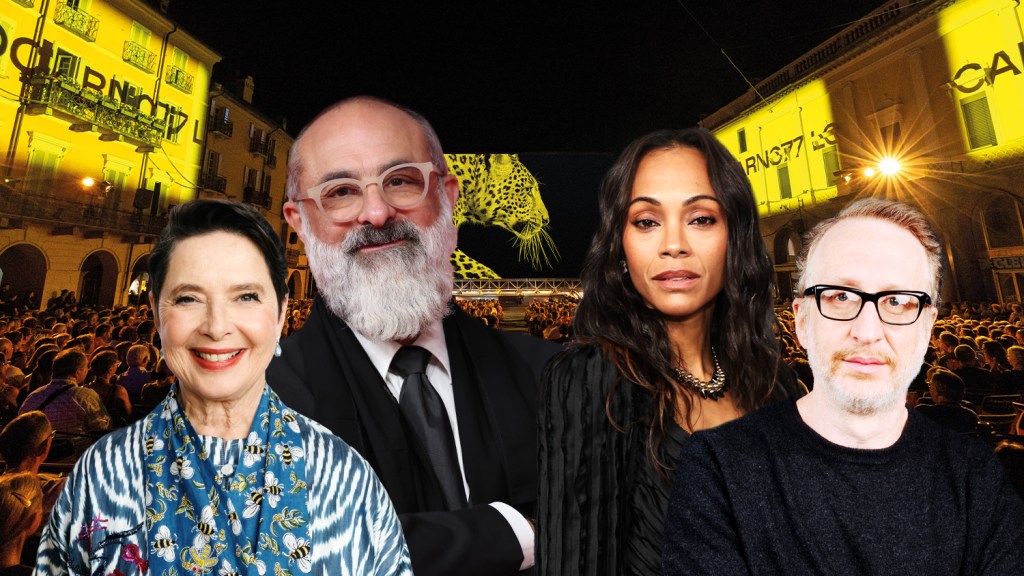
The opening ceremony will also see Isabella Rossellini feted with the festival’s Excellence Award, with further honorees across the festival including Darren Aronofsky, Virginie Efira, James Gray, Asia Argento, Rick Baker, Zoe Saldaña and producer Sigurjón “Joni” Sighvatsson.
Other star guests include Olivia Wilde with her $40M box office breakout The Invite; Monica Bellucci in the role of the aristocratic mother of a troubled teenager in Giovanni Tortorici’s Luca Guadagnino produced drama Ketticè and Claes Bang in post-WW2 intrigue I Is Another, all of which play on the Piazza Grande.
With the issue of migration into Europe hitting the headlines this past week after tens of thousands of people attempted to cross without permission from Morocco into the Spanish enclave of Ceuta, The Green Eyes is a timely opening film.
Set in the Landes in southwestern France, it follows 11-year-old Chaya whose brother goes into a mysterious deep sleep when their family is served with deportation papers. The drama takes its cue from so-called resignation syndrome, a state first observed in Sweden in the 1990s among the children of asylum seekers, which researchers suggested was sparked by trauma and a sense of powerlessness.
“The opening film is crucial. It’s like the opening beat of a concert,” says Locarno Film Festival Artistic Director Giona A Nazzaro.
“We wanted to share with the audience in Locarno that we’re fully aware of what’s going on in the world, but at the same time that we think we can tackle what’s going on through the tools of cinema, storytelling, imagination and fantasy,” he continues.
The Piazza Grande lineup traditionally showcases more accessible fare while independent world cinema competes for the Golden Leopard in the International Competition and edgier works by mainly but not only emerging directors are showcased in the Cineastes of the Present sidebar.
Nazzaro says he is not keen on making a distinction between “so-called public films” and “cinema for the highbrow few”.
“The real challenge today is to create a possibility where different forms of cinematic art can coexist with the same rights and dignity in the same public space of festival,” he says, adding his dream is to liberate spectators from preconceived viewing choices,” he explains.
“It’s a kind of dream to regain cinema as a freedom that can’t be predicted through algorithms or consumer habits… my aim is not to shape the program within the expectations of how cinema should be consumed today but rather create a space where cinema can be experienced as a discontinuation, or an interruption… welcome to Locarno, where your algorithm does not work anymore,” he continues.
Nazzaro says the diversity of the Locarno program builds on his work at Venice Critics’ Week, which he headed from 2016 to 2020.
“We aimed to welcome new filmmakers in Venice like Helena Wittman (Drift), Bertrand Mandico (The Wild Boys), Anna Eriksson (M), who were completely out of the box back in the day, and now have become, luckily, more established names,” he explains.
“What we try to say with a curated diversity is that obviously we have a limited number of slots, but we try to pick differences not only in subjects and stories, but also in the approach to the cinematic form.”
He gives artist Beatrice Gibson’s first feature At Night in the Cineastes of the Present, following six women traversing Paris after dark, as an example of a film ticking these boxes.
“It’s an outstanding film that tackles issues of identity and power representation, even in contexts and circumstances where you think we have moved on… it is extremely eloquent in the way it points to some of the very crucial crossing points of our contemporary conversations about where we are right now,” he explains.
Nazzaro highlights recent Cineastes of the Present success stories such as Sophy Romvari’s Blue Heron, which won Locarno’s First Feature Award, and then played in Toronto’s Centrepiece sidebar, clinching the Best Canadian Discovery Award, and the well-travelled Golden Leopard winner Sweetheart by Margherita Spampinato.
“Our DNA has always been about discovering new filmmakers, new talents, new possibilities for cinema. Locarno is one of the places where you can really dive into the possibilities for the art form today,” he says.
Under Nazzaro’s watch, Locarno has also welcomed pictures like Sony Pictures’ action-comedy Bullet Train starring Brad Pitt, but in a trend seen across the European festival circuit this year studio pictures are absent at this edition. He suggests it is a sign of the times.
“I’m a huge fan of North American cinema and what Hollywood used to stand for. I’m not oblivious to the changes, the industrial, financial, and structural transformation that the whole studio system is going through. I’m not even sure if there is still something like a studio system, not in the sense or way that we used to know it,” he says.
“That said, the collective intelligence of the Hollywood system is very much alive and expresses itself through unique artists such as Tom Cruise, and we’re also seeing how the system can work for an auteur like Chris Nolan and The Odyssey.”
“It’s always very risky to say definitively what is going on with the studios, because the strength of that system, whatever that system has become, is that it has in its DNA the capacity, the possibility, the opportunity to contradict itself at all times. Just a couple of weeks ago, we were all discussing Backrooms, which I think is extremely brilliant, and Obsession,” he continues, noting Locarno feted the latter’s executive producer Jason Blum with its Raimondo Rezzonico Award in 2022.
The U.S. is represented this year selection by Gray’s Paper Tiger and Wilde’s The Invite on the Piazza Grande as well as Greek American director Erin Vassilopoulos’s New Jersey and New York City-set drama Destroy All Girls in Cineastes of the Present. Restored versions of David Lynch’s Wild at Heart, Kevin Costner’s Dances With Wolves and Martin Scorsese’s Taxi Driver will also play on the Piazza Grande.
This year’s retrospective entitled ‘Red & Black – Hollywood Left and the Blacklist’ explores the filmmakers and films who fell victim to McCarthyism.
Restored by Zurich-based laboratory Cinegrell in collaboration with the Locarno Film Festival, the new 4K version of Dances of Wolves incorporates 30 minutes of previously unseen footage extending its duration to just under four hours.
Nazzaro suggests that while Costner’s revisionist Western epic may seem naïve today, it still represents an antidote to current U.S. politics.
“It’s like saying, ‘Ok, the hippies in Laurel Canyon were completely naive and stoned out of their heads most of the time but then came the 80s, and I’d rather go with the hippies than with the yuppies. You know what I’m saying?” he explains.
Currently tied up with the next instalments of Horizon – An American Saga, Costner is not scheduled to attend, but Nazzaro hopes the late night screening will be a cinephile event nonetheless, with at least a handful of spectators staying to the end in the small hours of the morning
“We’re aware of the time but the aim is to create an experience from which people might say, ‘I was there’. We’re not expecting 8,000 people to be there waiting for the sun to come up with the end credits but that’s the idea,” he says.
He recalls attending a screening of the 216-minute version of Michael Cimino’s Heaven’s Gate with the director in attendance in Venice in 2012.
“The director of the festival in Venice at the time [Alberto Barbera] had this very late night screening and was saying, “Guys, you have to see this film because the film will not be existing anymore. So, it was packed,” recounts.
“This is different. We’re bringing something back to life. The idea of going with that kind of film through the night with that kind of length is to say something very simple: you can win whatever night it is we are living through with the light of cinema.”