



Several years ago, Emmy Rossum saw director Bob Rafelson and screenwriter Ron Bass’ 1987 neo-noir thriller Black Widow, starring Debra Winger and Theresa Russell. She was immediately taken by it, and the notion that it could be updated for the modern day. Rather than a straight adaptation, however, Rossum saw the framework for something much more interesting — a long-form narrative that could expand upon the movie’s basic cat-and-mouse dynamic and, through a pair of very different female leads, unpack and explore issues of trauma and sexual acting out within the context of a crime thriller.
So Rossum began developing the material through her production company, Composition 8, and eventually connected and joined forces with an at least somewhat surface-unlikely partner in the form of creator and executive producer Elizabeth Meriweather, whose other credits include The New Girl, The Dropout and, most recently, Dying For Sex.
The fruit of their shared labor is the new show Furious, which recently made its premiere on Hulu and Hulu for Disney+ subscribers in the United States, and on Disney+ internationally. The eight-episode series is notionally being positioned as a limited-event offering, but it spoils nothing to say that the show ends on a note which could certainly continue with future seasons — albeit with a slightly different focus.
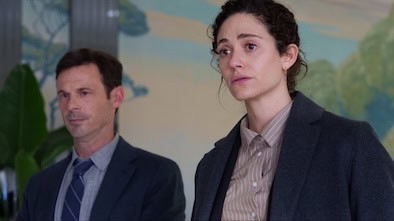
Furious centers on FBI agent Alice Black (Rossum), a former New York Police Department detective whose accusations of abuse against her ex-boyfriend Marshall Connelly (Jake Lacy), who still works for the NYPD, made her continued employment there untenable. Things get complicated when she gets called back by a former colleague, Danny Kelly (Scoot McNairy), to consult on a high-profile homicide investigation.
Alice quickly becomes convinced that the perpetrator is a female serial killer — one perhaps walking her own line of inverted vigilante justice, dispensing lethal doses of fentanyl to a series of wealthy men as payback for the unspeakable wrongs done to her as a sex-trafficked minor. That survivor is Catherine Grace (Lola Petticrew), whose story Furious also tracks in parallel. When she’s not focused on cutting a swath of retributive vengeance, Catherine serves as a caregiver to Alden (Ramy’s Steve Way), a homebound patient who nurses a crush on her.
As Alice navigates a somewhat turbulent new relationship with FBI mentor Nora Washington (Quincy Tyler Bernstine), a functional alcoholic ground down by the harshest realities of her job in the bureau’s sex crimes division, she also finds herself assigned to a joint task force, and dealing with complex feelings brought to the surface by being forced back into contact with her abusive ex. In wrapping these personal histories around a crime drama with a mystery hook (despite her rage and commitment to reprisal), Catherine can’t fully remember some of the specific circumstances of her abuse), Furious additionally manages to substantively explore questions of self-care and sadomasochism.
Recently, Brent Simon had an opportunity to participate in a virtual press conference for Furious. Excerpts from the conversation are as follows, condensed for the sake of length and clarity:
Question: Alice is chasing someone who does terrible things, but the series also seems interested in understanding why people become who they are, without necessarily asking us to forgive them. As both the lead actor and an executive producer, where did you draw your own line between encouraging empathy and accidentally inviting sympathy?
Emmy Rossum: Oh, that’s so interesting. …I think that as an actor, when you approach a role, if you’re playing the good guy or the bad guy, your job is to approach everything with empathy. And when a character is different than you, that’s what’s so exciting — to learn and excavate and cannibalize the parts of yourself that are the darkest, that scare you, to cannibalize things about your own life and your history for the purpose of bringing the character’s world to life and connecting and touching people that are ultimately watching this. I think storytelling is at its strongest when it confronts something in us, and it’s an opportunity to think about the world differently than we are. This is certainly a very different character than I’ve ever played — one who’s much more internal, much more reserved, who’s very disconnected from herself. And I think that’s true for both of the female characters — because of the violence that has happened in their past toward them, they are both kind of needing extremes to feel (things). And I think that, for me, is very different. I am somebody who is deeply feeling at all times — like the wind could blow, and I will feel everything. …This character, not only because they are a victim of violence, but also working in law enforcement, you have to disconnect from some of the softer, more feminine parts of yourself in order to do the job, in order to exist in a male-dominated field, and in order to exist in a field that has the intensity that this one does, year after year and decade after decade. There are some dark parts of this role and ways in which both of these characters are exhibiting really risky, dangerous behaviors. But I think that Liz, like, sets a fire, and then as the actors our job is to run toward it and and figure it out.
Question: Is it ever challenging for any of you to run towards the fire? Lola, playing a serial killer, is it hard to go home at the end of the day, or do you kind of get it all out on set?
Lola Petticrew: No, I mean, that’s my job. That’s the thing, that’s kind of why we all do it, and I think, like Emmy said, you can’t come in with your own moral judgments. It’s not interesting, it’s not for me to decide whether I think what Catherine does is good or bad — it’s for the audience. And, you know, (as an actor) you have to go home at night and pair your socks and fill the dishwasher, so, you know…
Question: Furious comes out in a time where there are the Epstein Files, and the trust into our institutions, whether that is law enforcement, the judicial, or federal, is at an all-time low. Can you talk about your own fury, if you have any, and how cathartic you feel your show actually can be for the fury that is clearly out there in society?
Elizabeth Meriwether: I mean, yeah… I have a lot of fury. I think there’s definitely a lot of fury out there. I think if I wanted the show to kind of just be angry, I don’t think it would be an interesting show. So I feel like I want it to talk about these issues and dig into them. I don’t have an answer (about) a simple kind of way to move forward. But I think it’s so important to dig into these feelings. I mean, I think anger can be a release. It can also trap you. And I think, like, some of the conversation about Catherine’s choices, I think… like yes, we’re rooting for her, but I also find a lot of pain in some of the choices that she’s making, because when anger consumes you, I think you lose a part of yourself and you lose a part of humanity in that moment as well. So I wanted to just dig into what anger can do to you as a person, and the ways that it can be released in kind of good and bad and complicated ways. Sometimes it may the only way forward, but then also it can kind of come back at you in bad ways, in sort of self-sabotaging ways, and trap you as well. But (as far as) the sweeping sort of bigger things that are going on, I can’t write from that place. I always kind of start from, like, a very human place. All (the other stuff) is very much in my mind and in my consciousness, but I think good writing really always has to be… at a just very character-based level, and not sort of making thesis statements about the world, because, you know, that’s what you do. That’s the journalist’s job, you know, and I feel like our job is to kind of dig in and get messy with some of this stuff.
Lola Petticrew: I think, as well, to frame the show to mirror one specific case (of a sexual predator) does a disservice to both the show and also to how deep the oppressive systems under the patriarchy and misogyny run, and how big they are and for how long it’s being going on. And I think, you know, we get a lot of questions framed almost as if… it’s in the culture just right now, as if it hasn’t always been in the culture, even harkening back to the name of the show and the Furies in ancient Greece. So I think to sort of boil it down to mirror one specific instance does everybody in the conversation a disservice.
Emmy Rossum: But I also think that there is a fury there, at society, women as a whole, what women have endured forever, throughout history. And I think you can’t just make it about one predator, because you could throw a dart and hit… a lot of predators who have been in the news over the course of the last 25 years or whatever. So I think our show is really about the women, and what I think is unfortunate about that one case is that we know that man’s name so well. I wish that we knew those women’s names and I wish that some of them were here to tell their stories.
Lola Petticrew: And there were a bunch of men in between, and that’s what this show, I think, is really good at showing as well — like, there’s the head of the snake and then there’s all of this other stuff in between. You know, it’s on every single level, all the way down.
Question: Emmy, from Shameless to Angelyne and now to Furious, your characters have kept shifting towards women who are harder and harder to morally classify. At what point in your career did you decide you no longer wanted to play the kind of roles an audience understands right away?
Emmy Rossum: Oh, that’s such a good question. I’m fascinated by moral gray areas, and I think the gift of no longer being an ingenue is the opportunity to play characters who are flawed and dynamic and who have history behind them. So I run toward those opportunities and often, you know, an agent will be like, “Probably most actors wouldn’t want to do this, so I’m gonna send it to you.” And I think those are some of the opportunities that (you mentioned) — even, you know, The Crowded Room, where I played a mother who was in denial about the sexual abuse of her child. I’m very interested in characters who cause me to feel some sort of way, who cause me to feel an initial judgment, or confusion, or shame. I run toward those opportunities because I think that that means there’s something that needs to be excavated about myself, about my own empathy, about society’s empathy. And I think with women in general, it’s very easy to say, like, “Oh, she’s the angel or devil, or good guy or bad guy.” I’m much more interested in the messiness of reality and human complexity. So yes, you’re sensing a trend, and you’re right to see that.